Amy Brown Science | Biology and Chemistry Teaching Resources for Middle and High School
menu Home About Me Home Freebies My Store
Amy Brown Science Facebook    Amy Brown Science Instagram    Amy Brown Science Pinterest    Amy Brown Science Teachers Pay Teachers    Email Amy Brown Science

Search My Blog

Real Science Teaching. Real Classroom Experience.

I’m Amy Brown, a veteran high school biology and chemistry teacher, wife, and mom who understands the daily reality of lesson planning, grading, meetings, and everything in between. I know what it feels like to have too much to do and not enough time to do it.

After decades in the classroom, I’ve created rigorous, classroom-tested biology and chemistry resources that save you planning time while still delivering strong, meaningful science instruction. Every lab, activity, and lesson is designed to move students beyond memorization and into real scientific thinking.

If you want your students excited about science and thinking deeply without spending your entire weekend planning, you’re in the right place.

Amy Brown Biology and Chemistry Teacher

“I just love getting kids hooked on science.”

Teaching Students to Read Science Informational Text


Science surrounds us every single day. From shopping at the grocery store for probiotic yogurts and organically grown produce to news stories on earthquakes, climate change, vaccines, and toxic chemical clouds produced from a train derailment. As a result, it is more important than ever that we teach our science students how to read "science informational text." 

In today’s world, students must be able to read, comprehend, and analyze science informational reading passages!

  • The science students of today will be the decisions-makers of tomorrow. 
  • Students must be able to function in a technical world.
  • It is increasingly important that students be able to discern fact from fiction, and fact from opinion.
  • The reading of "science informational text" helps students develop critical-thinking and problem-solving skills.
  • Reading scientific text can help students develop the language and vocabulary necessary to communicate effectively about scientific topics.
  • Reading and comprehending scientific text is a fundamental skill required for students to score well on college admission tests, such as the ACT.
  • Basic life decisions depend on the ability to read and understand science informational text. For example, "What are the pros and cons of purchasing an electric vehicle?"

The face of science teaching is changing. Common Core Science Standards, as well as the Next Generation Science Standards, are asking teachers to emphasis scientific concepts, rather than the memorization of large amounts of factual data. 

Click any image to view in my TPT store.

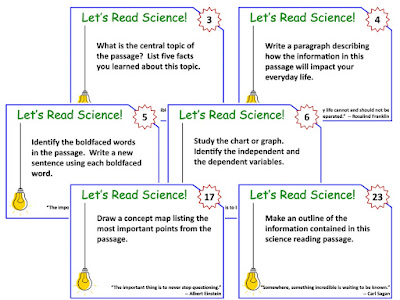
For many science teachers, the thought of having to teach students "how to read science" can be overwhelming. However, it's actually a lot easier than you might think. After all, we are already asking our science students to read the textbook, lab handouts, etc. With a few simple tools (Try my Science Reading Task Cards!) and a little planning, you can easily teach your students how to be better readers of science informational passages.

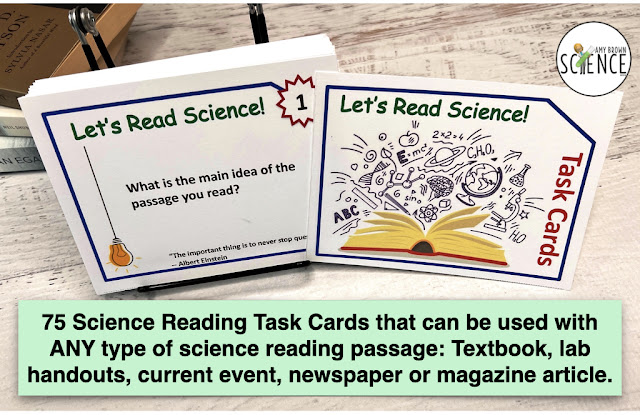
Students need to practice the skill of reading in science. When students are reading, they need to be given prompts on what to look for in the reading. To accomplish this, I developed a set of 75 Science Reading Task Cards that can be used with ANY type of science reading material. These task cards can be used in all science classes and with students in Grades 6 - 12. 


Each task card asks students to pull out specific information from the material they are reading. The task cards focus student attention and help them to determine the main idea, the purpose of an experiment, how to read a chart or graph, or whether the reading passage is based on fact or opinion.

Start by using a reading passage that we science teachers already use every day .... the TEXTBOOK! Ask the students to read a short section from their textbook. Provide 3 to 4 task cards to go along with the reading and ask students to write out answers for each task card question.


Tired of trying to get your students to read the lab handouts before lab day? Ten of the task cards from the set are designed just for this purpose. By answering these ten task card questions, students must read the lab handouts to write a hypothesis, identify variables, and make predictions about the outcome. 

Once your students become familiar with using the task cards while reading their textbook and lab handouts, start adding in an occasional current event article from a newspaper or magazine. You might even work up to assigning a book such as "The Double Helix" or "The Hot Zone."


The set of "Science Reading Task Cards" is available in my TPT store.  Additional information about the task cards includes:

  • The set contains 75 task cards.
  • There are different formats included: (1) Printable and editable version, (2) PowerPoint version to use with your classroom projection system, (3) Google Slides version with included text boxes for students to write in answers, (4) Google Forms version.
  • The cards can be used with any type of science reading material.
  • The cards are appropriate for Grades 6 - 12.
  • PLEASE NOTE:  Science reading passages are NOT included. The teacher must find and choose appropriate reading passages to use.
  • The set includes a detailed Teacher Guide as well as correlation to Common Core (CCSS) Standards.

Looking for ideas on using science graphic organizers in your classroom? Read my blog post about science graphic organizers for reading, writing, and analyzing scientific information.

Looking for a simple way to strengthen science vocabulary? My Biology Prefixes and Suffixes activity helps students decode unfamiliar scientific terms by breaking words into meaningful parts.

Looking for more classroom ideas? Be sure to read my blog post, The Ultimate Guide to Teaching Science Process Skills, where you'll find dozens of teaching strategies, classroom activities, and science resources all in one place.

Periodic Table Review Game and Periodic Trends Activity

You've just finished teaching the periodic table to your high school chemistry or physical science students. You've covered periods, groups, valence electrons, metals, nonmetals, and important periodic trends. You've explained atomic radius, electronegativity, and ionization energy, and you're feeling pretty good about how well your students understand the material. Surely they're ready for the unit test!

Then you notice a few glazed-over looks. Students can repeat the definitions, but can they actually apply what they've learned? It might be time for a periodic table review game that requires a little more thinking!

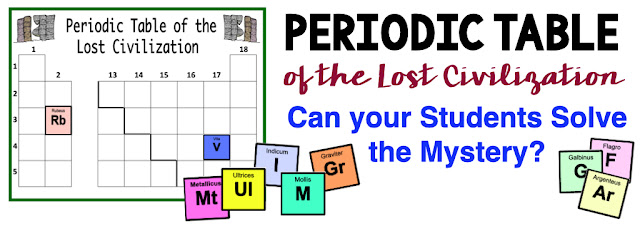
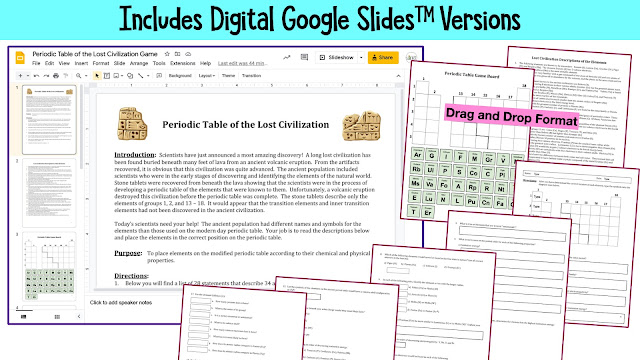
One of the best ways to determine whether students really understand a science concept is to ask them to apply their knowledge to an unfamiliar situation. That's exactly what students do in Periodic Table of the Lost Civilization, a mystery-based periodic table review activity that challenges students to reconstruct an ancient periodic table using clues about fictional elements and their properties.

A Periodic Table Mystery: The Lost Civilization

Here's the story! A long-lost civilization has been discovered buried beneath many feet of lava from an ancient volcanic eruption. The civilization was home to scientists who were just beginning to discover and identify the elements of the natural world. Unfortunately, the volcanic eruption destroyed their civilization before they could complete their periodic table.

These ancient scientists used different names and symbols for the elements than we use today. Students must take on the role of modern scientists and figure out how the ancient civilization organized its elements.

Students receive 28 clues describing 34 fictional elements. Each clue provides information about an element's chemical or physical properties, its position relative to other elements, or its behavior. Using their knowledge of periodic table organization and periodic trends, students determine where the elements belong on the lost civilization's periodic table.

Using Periodic Trends to Solve the Mystery

What I love about this periodic trends review activity is that students cannot complete it by simply memorizing vocabulary or copying information from a periodic table. They must understand how the periodic table is organized and use that knowledge to make decisions about where each element belongs.

For example, students must apply their understanding of groups and periods, valence electrons, electron energy levels, element reactivity, and the properties of metals, nonmetals, and metalloids. They also use periodic trends such as atomic radius, electronegativity, and ionization energy to recognize relationships among the fictional elements.

Here are a few examples of the clues students must interpret:

  • The following elements are known to be unreactive: Scansio (S), Lumen (Lu), Graviter (Gr), Piger (Pi), and Respiro (Rp). The element Scansio (S) has 2 valence electrons.
  • Flavus (Fa) is the most reactive of the nonmetals.
  • The atomic radius of Lumen (Lu) is much smaller than the atomic radius of Respiro (Rp).
  • Piger (Pi) has valence electrons in the third energy level.

Each clue requires students to think about what they already know. If an element is extremely reactive, where might it belong? What can its valence electrons tell them about its location? How can atomic radius help them determine which of two elements should be placed higher or lower in the same group?

Students work through the clues, compare information, eliminate incorrect possibilities, and gradually complete the ancient periodic table. As more elements fall into place, the patterns become clearer. I especially enjoy watching those light-bulb moments when students realize that a clue they couldn't solve earlier suddenly makes perfect sense!

More Than a Game: Periodic Table Review and Critical Thinking

Although students approach this as a mystery game, the real purpose is to strengthen their understanding of chemistry. Rather than answering isolated questions about periodic trends, they must use several concepts together to solve a larger problem.

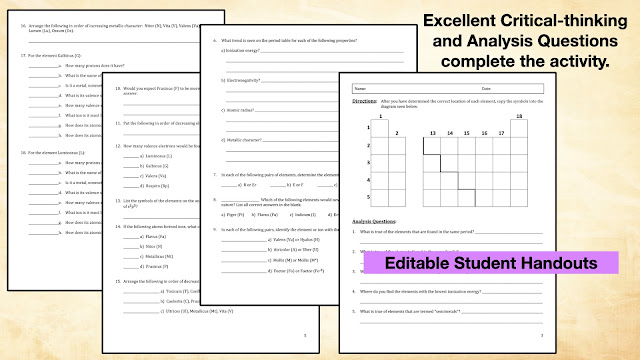
The activity also includes 18 analysis questions that give students additional opportunities to explain their reasoning, interpret periodic trends, and demonstrate what they understand about the organization of the periodic table.

These questions are especially helpful when preparing students for a periodic table or periodic trends test. They provide another way to see whether students truly understand the relationships among elements rather than simply remembering a list of definitions.

Printable, Editable, and Digital Periodic Table Activity

I prefer having students work with printed materials whenever possible, particularly for an activity like this one. There is something satisfying about physically arranging the element squares, moving them around as new information becomes available, and finally seeing the completed periodic table take shape.

However, I also know that teachers need flexibility. This periodic table activity includes printable student materials, editable handouts, and a digital Google Slides version. In the digital activity, students drag and drop the fictional element squares into the correct positions on the ancient periodic table.

Whether students work with the printable element cards or the digital version, the goal remains the same: apply their chemistry knowledge to solve the mystery. The different formats make it easier to use the activity in a traditional classroom, with partners or small groups, or as an individual review assignment.

When to Use This Periodic Table Review Activity

I especially like using this activity after students have learned the structure of the periodic table and the major periodic trends. It makes an excellent review before a unit test because students must bring together information from several lessons and use it to solve a problem.

It also works well as a partner or small-group activity. Students can discuss the clues, explain their reasoning, and challenge one another's ideas as they decide where the elements belong.

For students who finish the mystery, the analysis questions provide a natural follow-up. Teachers can also use the activity as a cumulative review later in the course when students need to revisit periodic table organization and periodic trends.

Ready to Try the Periodic Table of the Lost Civilization?

If you're looking for a periodic table review game that gets students thinking, discussing, and applying their knowledge, I hope you'll give this one a try. It combines the challenge of a mystery with the important chemistry concepts students need to master before moving forward in the course.

The resource includes the ancient civilization storyline, 28 element clues, 34 fictional elements, the periodic table activity, 18 analysis questions, and printable, editable, and digital options. You can see the complete resource and preview the included materials in my TpT store.

View the Periodic Table Review Game and Periodic Trends Activity on Teachers Pay Teachers →

More High School Chemistry Teaching Ideas

If you're looking for more ways to help students connect chemistry concepts to real scientific thinking, you might also enjoy my flame test chemistry lab. It's one of my favorite hands-on activities for helping students understand electron energy levels, excited electrons, and why different elements produce characteristic flame colors.

Students also need a strong foundation in the mathematical skills used throughout chemistry. My post on chemistry math skills, scientific measurement, and problem solving explains common student difficulties and offers ideas for building the skills students need to succeed in their chemistry coursework.

No matter what chemistry topic you're teaching, I believe students learn best when they're given opportunities to think, investigate, and apply what they've learned. That's what makes activities like this so rewarding to use in the classroom.

Have fun teaching!

Science Skills Lab Stations: 17 Science Activities for Middle and High School

Science Skills Lab Stations: 17 ready-to-use activities for grades 9-12 covering graphing, scientific method, metric measurement, data analysis, scientific notation, and lab equipment.

Teaching essential science skills at the beginning of the school year is one of the best investments you can make as a middle or high school science teacher. Before students can be successful in biology, chemistry, physical science, or environmental science, they need to know how to use laboratory equipment, collect accurate data, create graphs, make observations, and think like scientists. When students master these foundational science skills early in the year, labs run more smoothly, students become more independent, and you spend less time answering the same questions over and over.

👉 Science Skills Chat Lab Station Activities

If you've taught science for any length of time, you've probably heard questions like these:

  • Which one of these is the graduated cylinder?
  • How do I convert from decimeters to decameters?
  • I can't do scientific notation on my calculator.
  • What are independent and dependent variables, and where do they go on a graph?
  • You wanted the graph on graph paper?
  • I measured exactly 5 grams of salt! (...in a beaker that was never massed.)
  • What do I do next?

Sound familiar?

If you're looking for a back-to-school science activity that reviews laboratory equipment, graphing, metric measurement, scientific notation, and the scientific method, these science skills lab stations are an easy way to prepare students before their first major lab. They work well in biology, chemistry, physical science, environmental science, and general science classrooms.

Students come to us with very different science backgrounds. Some are already comfortable with graphing, measurement, lab equipment, and the scientific method. Others are still learning how to read a graduated cylinder or identify the independent variable in an experiment.

That is why I believe strongly in teaching these foundational science skills before students begin more advanced labs. The time you invest early in the school year will pay off all year long.

That's exactly why I created Science Skills Chat Lab Stations, a set of 17 ready-to-use science lab stations for middle and high school classrooms that help students review graphing, metric measurement, scientific notation, laboratory equipment, the scientific method, and other foundational science skills before they begin your major lab activities.

👉 You can take a closer look at Science Skills Chat here.

Science Skills Activities That Prepare Students for the Lab

Science content changes from unit to unit, but science skills are used all year. Students need to measure, observe, calculate, graph, analyze, and communicate results whether they are studying biology, chemistry, physical science, or environmental science.

A great place to begin is with basic laboratory equipment. If students are comfortable using a graduated cylinder, metric ruler, laboratory balance, and Celsius thermometer, they will be ready when those tools are used in future lab investigations.

Science Skills Chat lab stations that teach students to use a graduated cylinder, Celsius thermometer, metric ruler, and laboratory balance before beginning science labs.

Why Science Skills Lab Stations Work Better Than a Lecture

Students do not learn to use science skills by listening to teachers talk about them. They learn by practicing. They learn by making mistakes, asking questions, correcting those mistakes, and trying again.

This is especially true for skills such as scientific notation, the scientific method, metric units, and graphing. These are not one-time lessons. Students need repeated practice with them in a setting where they can talk through the process.

Science Skills Chat activities that teach foundational science process skills, including scientific notation, the scientific method, metric SI units, and graphing and data analysis.

How to Use These Science Skills Chat Lab Stations

One of the questions I hear most often is, "How do you fit 17 stations into your schedule?"

It's a mistake to try to fit in all 17 lab stations in one activity. I usually choose four or five stations that match the skills students need before an upcoming lab. For example, before our first investigation, students might rotate through the graduated cylinder, metric ruler, laboratory balance, and Celsius thermometer stations.

Later in the year, I pull out different stations before teaching graphing, scientific notation, or the scientific method. Because each activity stands alone, the stations become a resource I can use all year instead of just during the first week of school.

Why I Created These Science Skills Chat Lab Stations

To help my students review and strengthen these skills, I created Science Skills Chat, a set of 17 collaborative lab stations focused on the essential skills students need in science class.

I use the word chat on purpose. Students are not meant to sit silently and complete worksheets in isolation. They are expected to work together, talk through problems, ask questions, and help one another understand the skill being practiced at each station.

This kind of peer tutoring is powerful. I like to arrange groups so that each group has at least one strong student. Students who are less confident often feel more comfortable asking a classmate for help than raising their hand and asking the teacher in front of the whole class. At the same time, the stronger students deepen their own understanding by explaining their thinking to someone else.

Three hands-on Science Skills Chat lab stations featuring a laboratory equipment card sort, graduated cylinder measurement, and scientific method with graphing activities for high school science students.

A Favorite Station: Lab Equipment Card Sort

One of my favorite stations is the Lab Equipment Card Sort. Students work together to match 42 common pieces of laboratory equipment with their names and functions.

This station is a great example of why the "chat" format works so well. Students are not just memorizing a list of equipment names. They are looking at the equipment, reading the function cards, discussing possibilities, and making decisions together. That kind of interaction helps the information stick.

Students complete a collaborative laboratory equipment card sort activity by matching 42 common science tools with their names and functions in Science Skills Chat lab stations.

The Scientific Method Station

The scientific method is another skill that students will use again and again. In this station, students practice identifying variables, designing an experiment, organizing data, graphing results, and drawing conclusions.

I like this station because it pulls together so many important science process skills in one place. Students are not just defining vocabulary words. They are applying the scientific method to an actual scenario and using data to support a conclusion.

Scientific Method lab station where students identify variables, analyze experimental design, graph data, and draw conclusions while working collaboratively in small groups.

What Skills Are Included?

Science Skills Chat includes 17 lab stations. Some require lab equipment, while others can be completed in the classroom or even used as homework or sub plans.

The stations include:

  • Metric Units
  • Identification of Lab Equipment
  • Scientific Notation
  • Dimensional Analysis
  • Significant Digits
  • The Scientific Method
  • Tabling, Graphing, and Analyzing Data
  • The Graduated Cylinder
  • The Metric Ruler
  • The Laboratory Balance
  • The Celsius Thermometer
  • The Bunsen Burner
  • Determining the Volume of Solids
  • Separating a Mixture
  • Determining Density
  • Accuracy, Precision, and Percentage Error
  • Scientific Drawings

You Do Not Have to Complete All 17 Stations at Once

You do not have to complete all 17 lab stations in a multi-day marathon session. That would be too much for most classes, and student retention of the skills would suffer.

I suggest choosing 4 or 5 stations that match the skills your students need most right away. For example, if you are getting ready to begin your first lab, you may want students to practice using the graduated cylinder, laboratory balance, metric ruler, and Celsius thermometer first.

Later in the year, you can pull out another group of stations when those skills are needed. This makes the resource useful long after the first week of school.

Science Skills Chat lab stations can be used throughout the year to review individual science skills as students need extra practice.

Try Science Skills Friday

One of my favorite ways to use this resource is to create a "Science Skills Friday." Choose a small group of stations and use them as a weekly review and reinforcement day.

This works especially well because students are not overwhelmed by too many stations at once. They get focused practice on a few important skills, and the completed handouts can be kept in a notebook for reference later in the year.

You can also use individual stations for review before a lab, intervention, early finishers, or emergency sub plans. Some stations do require lab equipment, but several can be completed without a full lab setup.

What Is Included in Science Skills Chat?

This resource includes everything you need to set up the stations and guide students through the activities.

Science Skills Chat includes 17 collaborative lab stations, student handouts, lab station instruction cards, a 12-page teacher guide, a 30-page answer key, and editable files.

  • 17 collaborative science skills lab stations
  • Student handouts
  • Lab station instruction cards
  • 12-page teacher guide
  • 30-page answer key
  • Editable files

"I used these during the first two weeks of school, and my students were so much more confident during our first full lab! Total game-changer." – Melissa B., HS Biology Teacher

Ready to Help Your Students Master Essential Science Skills?

If your students need practice with lab equipment, graphing, metric measurement, scientific notation, scientific method, or other foundational science skills, Science Skills Chat gives you a ready-to-use way to build those skills through discussion, collaboration, and hands-on practice.

Because the stations are ready to print and use, you spend your time helping students learn instead of creating review activities from scratch. As the year goes on, you will spend less time reteaching basic skills and more time helping students think, investigate, and understand the science content in front of them.

And honestly, how nice would it be to reduce the number of questions you get every time you go to the lab?

View Science Skills Chat in my TpT store.

Whether you teach biology, chemistry, physical science, environmental science, or general science, these foundational skills will prepare your students for a successful year in the laboratory.

Looking for more classroom ideas? Be sure to read my blog post, The Ultimate Guide to Teaching Science Process Skills, where you'll find dozens of teaching strategies, classroom activities, and science resources all in one place.

Frequently Asked Questions

When should I teach science skills?

I like to teach these science skills during the first few weeks of school before students begin more complex laboratory investigations. Building these skills early helps students become more confident using lab equipment, collecting data, graphing results, and designing experiments. I also revisit individual skills throughout the year whenever students need a refresher.

What grade levels are these science lab stations designed for?

Science Skills Chat was created primarily for middle school and high school science classrooms. The activities work well in biology, chemistry, physical science, environmental science, and integrated science courses. Many teachers also use them with honors classes, intervention groups, or as review before major labs.

Do students complete all 17 stations at one time?

No. I don't recommend this.

I usually choose four or five stations that match the skills my students need before an upcoming lab. Later in the year, I bring out different stations as those skills become important. This makes the resource useful throughout the entire school year instead of only during back-to-school season.

What science skills do students practice?

Students review many of the science process skills they use all year long, including laboratory equipment, metric measurement, scientific notation, graphing, data analysis, significant figures, dimensional analysis, scientific drawings, density, the scientific method, and experimental design.

Can these science activities be used for sub plans or review?

Absolutely. While several stations require laboratory equipment, many can be completed in a regular classroom without a lab setup. Teachers frequently use them for review days, intervention, early finishers, science stations, and emergency sub plans.

How much preparation is required for these science lab stations?

The amount of preparation depends on the stations you choose. The resource includes student handouts, station instruction cards, a teacher guide, answer keys, and editable files. Some stations only require printing, while others use common laboratory equipment such as graduated cylinders, balances, rulers, and thermometers.

Related Science Skills Blog Posts

If you are looking for more ideas for building science skills at the beginning of the year, these blog posts may also help:

Are your students struggling with the math side of chemistry? Before students can be successful in a chemistry class, they need a strong foundation in scientific measurements, significant figures, scientific notation, dimensional analysis, graphing, and more. This blog post tells you how I teach these essential skills, and shows examples of my complete Chemistry Measurement Unit that prepares students for success all year long.


Amy Brown Science signature logo

Technology Chat: Make Sure Your Students Are Ready for Digital Learning


Returning to school after summer break is stressful in the best of times.  I think we can all agree that this is pretty much the WORST of times and that this year's return to teaching will be unlike any other.  We teachers have faced many challenges before, but the challenges before us now are unprecedented.  Whether you will be teaching virtually, in-person, or somewhere in between, you will find yourself in need of digital resources to support your curriculum.  The reality of teaching in the days of COVID-19 means that student absenteeism will fluctuate wildly, many parents may opt to keep their kids at home, or schools may be forced to close altogether.  This puts you in the challenging position of not only teaching your core science material, but also teaching students about your chosen (or chosen for you ...) method of virtual instruction.  This can be overwhelming.  You need activities that support the technical instruction of your students as well as their science instruction.


When students arrive in your classroom this fall, either in person or virtually, will they all have the same set of skills in using Google Apps?

The short answer is ... No.  On the first day of class, just as our students have different graphing skills, or math skills, or writing skills, they will cover the spectrum in their ability to use Google Apps.
On that note, I am very excited to introduce a new tool in your teaching arsenal:  Technology Chat for Google Apps!  If you plan on utilizing Google DriveTM or Google ClassroomTM this fall, this is a fantastic activity to set your students up for success by teaching them a basic set of skills for the Google Apps.  Your students will learn how to create and share Docs, Slides, and Sheets as well as many of the features used to complete assignments in Google Apps.

If you are not familiar with my other "Chat" activities, they are highly collaborative in nature and allow students to work together while mastering new material.  This activity is a little different in that students can complete it remotely, in-person, or in pairs.  If you are meeting students face-to-face, I highly recommend using the activity in cooperative learning groups.  Peer help and instruction is a valuable learning tool.  Whatever your teaching situation, Technology Chat is an extremely flexible activity that will fit with any teaching situation.


While this activity won't cover everything Google has to offer, it is a great tool to create a baseline of knowledge in your classroom and hopefully give your students enough technical know-how to start the year off right.

Teachers always rise to face new challenges, and this school year will be no different. In these unprecedented times, I am excited to see the amazing ways our community serves our students and the highly innovative new solutions we put into place in our classrooms.  I hope this activity is a helpful addition to your back-to-school instructional plan.  I wish you all the very best of luck this fall.

Going Digital in the Age of Distance Learning


Hello everyone!  Wow, in just a few short weeks our teaching world has been rocked to the core.  If you had told me months ago that we would be in this shape today, I would have thought you had lost your mind. Unprecedented school closures have all of us scratching our heads and trying to figure out how to get through just one day at a time.  Both teachers and parents are scrambling to look for resources for our students that can be used digitally for distance learning.  Since it looks like schools are going to closed for some time, it's "all hands on deck" as we deal with the problems of educating children remotely.  

So let me get right to it.  The purpose of this post is to let you know about resources that are available for both teachers and parents in the world of "distance learning."  The rest of this post will consist of clickable links to resources you might find helpful.

First, I am working to convert the resources in my TpT store over to digital formats for use in Goggle Drive, Google Classroom, and/or Microsoft OneDrive.  As resources are updated with the digital version, I will add them to the "already posted" printable listing on TpT.  In short, this means that if you have purchased a resource from my TpT store, you will be able to download the resource again, at no extra cost, to receive the digital version if one becomes available.  Full disclosure: Converting items to digital resources is time-consuming and tedious work. My resources will not magically appear in digital format overnight, but I will add them as fast as I am able.


Just a reminder:  Do you know how to determine if a resource you have purchased on TpT has been updated? You will not get email notifications from TpT when resources are updated. You'll need to navigate to your "My Purchases" page on TpT and look for notifications that appear with any resources that have been updated.

What items at Amy Brown Science have been updated with new digital formats?
I started with my free resources.  The following resources have been updated. Each includes a detailed Teacher Guide to help you navigate the world of Google Drive.  I have also included a QuickStart Guide for the experienced users.  Click the images or red text below to grab these free distance learning resources:


Backyard Ecology:  This ecology activity is perfect for laying the groundwork prior to your ecology unit. The questionnaire will get your students thinking about the ecology and environmental issues of your local community.


Monohybrid Mice! is great for Punnett Square practice.  These problems are on a beginner level and a perfect way to introduce one-factor genetics problems to your students.


DNA Informational Text Reading: This reading is based on Watson and Crick's famous one-page article published in 1953 in Nature magazine, announcing their discovery of the structure of the DNA molecule. It comes with graphic organizers to help your students read and understand this classic scientific paper.


Compare and Contrast Graphic Organizer: This very simple, two-page graphic organizer has become one of the best study and review techniques that I use in my science classes. It forces students to think deeply about two topics or concepts as they search to find the similarities and differences between them. 


Cell Respiration Word Game Review: This review activity is designed to help your students master the difficult vocabulary in a cell respiration unit. 


I have also created a new custom category in my TpT store called "Digital / Google Apps" where you can find all of my digital resources. Clicking the link to this custom category will sort my store to show all of my digital resources. This is a great link to save.  It will allow you to see if any of the resources you have previously purchased have been updated for Google Apps.

Let me ask a favor of you: Please respect my copyright by NOT posting my resources on a public web site where my resources can be accessed by a Google search and the public world.  You are welcome to post to your own password-protected class site as long as only your students have access.  Thanks so much for your understanding.

One more thing before I move on to other suggestions for resources:  Signing up for my free newsletter is a good way to receive notifications for updates, exclusive freebies, promotions, sales, and news.  Click this link if you are interested in my newsletter.

Okay, now I am going to post links to all sorts of things that I have seen over the last few weeks that I think might be helpful to you.


Please note: All online learning sites should be throughly vetted by teachers and parents before allowing access to your students.

I hope that this post gives you some places to start as you begin your journey into distance learning.  Good luck to you, and please stay well!

P.S. The adorable "Dot Dudes" in the heading image are the copyrighted work of Sarah Pecorino Illustration.

Food Testing Lab for Organic Compounds in High School Biology

A biochemistry lab that tests foods for organic compounds is one of the most effective ways to help students understand macromolecules in a real classroom setting. In this food testing lab, students identify sugars, starches, proteins, lipids, and vitamin C by using common indicator tests such as Benedict’s solution, iodine, Biuret reagent, and indophenol.

If you are looking for a high school biology lab that combines hands on investigation with clear, visual results, this activity helps students connect abstract chemistry concepts to the foods they eat every day while reinforcing your biochemistry curriculum.

Biochemistry lab testing foods for organic compounds showing common foods used to test sugars starches proteins and lipids in high school biology

What Is a Food Testing Lab for Organic Compounds?

This lab is best used during your biochemistry unit when students are learning about carbohydrates, proteins, and lipids. Teaching the characteristics of macromolecules can sometimes feel dry and abstract, so this lab is a great way to break up direct instruction and give students a practical application of the concepts you are teaching.

This lab activity is a two part activity. First, students learn the indicator tests for sugars, starches, proteins, fats, vitamin C, and salt using known solutions. Once students understand how to complete these tests and recognize the results, they test a wide variety of foods to determine which compounds are present.

Tests for Organic Compounds in Food

Before any testing of foods is carried out, students need to practice each indicator test. For example, in order to determine whether milk contains simple sugars, students must first know how to carry out the test for simple sugars and what a positive result looks like. This first part of the lab gives students that practice and helps them interpret their results correctly when they move on to testing foods.

Students learn the positive and negative tests for the following:

  • Students test for starch using iodine.
  • Students test for simple sugars using Benedict's solution.
  • Students test for proteins using Biuret reagent.
  • Students test for lipids using the brown paper test.
  • Students test for the presence of vitamin C using indophenol.
  • Students test for salt using silver nitrate.

Please note: Obviously, salt is not an organic compound. However, it is a fun test for students to carry out, and it provides interesting information about the foods we eat.

Benedicts iodine Biuret and indophenol tests showing color changes for organic compounds in food

Materials Needed for a Food Testing Lab

This lab uses simple materials that are manageable in a classroom setting and easy to prepare ahead of time.

  • Test tubes and test tube racks
  • Glucose solution
  • Starch solution
  • Protein solution
  • Fat or oil
  • Iodine
  • Benedict’s solution
  • Biuret solution
  • Brown paper
  • Hot water bath
  • Vitamin C solution
  • Indophenol
  • NaCl solution
  • Silver nitrate
  • A variety of foods
Biochemistry lab setup for testing foods with Benedicts solution iodine Biuret solution and test tubes

How Students Analyze Results in This Lab

Once students know how to use the indicators, the real fun begins. You can choose a variety of foods for students to test. While you can theoretically use many different foods, some are easier to test than others. Dark purple grape juice, for example, can be frustrating because students may have difficulty seeing the color changes clearly.

I usually get the best results with foods such as milk, yogurt, egg whites, egg yolks, potatoes, celery, cereals, and an assortment of fruit juices. Liquid foods can be used straight from their containers. For solid foods, you will need to prepare a solution using a blender. Students then record observations, identify which compounds are present, and compare results across different foods. This is also a great opportunity for students to organize data tables or write lab reports about their findings.

Why This Biochemistry Lab Works So Well in the Classroom

  • First and foremost, it is just plain fun. When students love your lab activities, they are more excited about your class.
  • This lab reviews and reinforces the concepts you have been teaching. Facts about macromolecules are easier to learn and remember when students see a practical application of the information.
  • This lab teaches good lab techniques, how to organize data, and how to work cooperatively in groups.
  • Students are often surprised to learn that a food they thought was healthy may be mostly sugar and salt.
  • Working through detailed lab procedures teaches students to read, understand, and follow directions carefully.
  • Students use critical thinking and problem solving skills throughout the activity.

More Biochemistry Activities for Your Classroom

If you are planning a full biochemistry unit, these related blog posts can help reinforce key concepts and provide additional hands on experiences for your students:

Organic compounds food testing lab worksheet high school biology data tables and analysis questions

Ready to Use Biochemistry Lab Activity

Above you can see the lab handouts that I use with my students. If you want a complete, ready to use version of this food testing lab with student worksheets, data tables, answer keys, and teacher directions, you can find it in my TpT store.

Click here to view the complete biochemistry lab activity

Frequently Asked Questions About Food Testing Labs

What are the main tests for organic compounds?
Benedict’s test for sugars, iodine for starch, Biuret for protein, and paper or Sudan test for lipids.

What foods work best for this lab?
Milk, yogurt, egg whites, egg yolks, potatoes, cereals, celery, and fruit juices typically produce clear results.

Why do the colors change during testing?
Each indicator reacts chemically with specific molecules, producing visible color changes that signal the presence of those compounds.

Is this lab appropriate for high school biology?
Yes. This lab is ideal for grades 9 to 12 and can be adapted for different ability levels.

Book Review and Giveaway: "Awesome Physics Experiments for Kids"


It's not often that I do a product review.  And since you are now reading a product review, that should tell you that I am super-excited about this product!  Erica Colon (NittyGrittyScience.com) has written a fabulous set of experiments for young budding scientists, ages 10 to 13.  But this is more than just another science experiment book.  This is a book for parents and for families, and also a fantastic resource for science teachers.

Let's start with parents and families.  All of the experiments in this book can be carried out with simple materials, and anyone can do them!  No science background is required because Erica has included every single thing you need.  Here's what you'll find with each experiment:

  • Title
  • Problem or Question
  • Level of Difficulty (Easy, Medium, Difficult)
  • Time Suggestion
  • Materials List
  • The Steps
  • Now Try This!
  • The Hows and Whys
All parents will be able to do these experiments with their kids.  The procedural steps are clear and concise, and the final section is a life-saver if your background is not in science.  "The Hows and Whys" section will ensure that you can discuss these concepts with your children.

Now, let me speak to science teachers:  While these experiments were written for children of ages 10 to 13, these activities can easily be used as experiments and/or demonstrations from middle school classes up through high school physics classes.  What a relief to find activities that don't require expensive lab equipment!  And, if you love stem challenges, this book is perfect for you! And one more thing:  The activities are aligned with NGSS standards.

Here's a sample experiment that you can start using right away:


In addition to 40 super science experiments, Erica has included a Glossary of terms, Measurement conversions, Resources for kids, Resources for teachers, Blank tables and graphing grids, and an Index.

The book is being released through Amazon.  Click this link to view on Amazon.