
menu Home About Me Home Freebies My Store
Amy Brown Science Facebook    Amy Brown Science Instagram    Amy Brown Science Pinterest    Amy Brown Science Teachers Pay Teachers    Email Amy Brown Science

Search My Blog

Real Science Teaching. Real Classroom Experience.

I’m Amy Brown, a veteran high school biology and chemistry teacher, wife, and mom who understands the daily reality of lesson planning, grading, meetings, and everything in between. I know what it feels like to have too much to do and not enough time to do it.

After decades in the classroom, I’ve created rigorous, classroom-tested biology and chemistry resources that save you planning time while still delivering strong, meaningful science instruction. Every lab, activity, and lesson is designed to move students beyond memorization and into real scientific thinking.

If you want your students excited about science and thinking deeply without spending your entire weekend planning, you’re in the right place.

Amy Brown Biology and Chemistry Teacher

“I just love getting kids hooked on science.”

Showing posts with label graphing. Show all posts

5 Science Skills Your Students Are Missing (and Easy Ways to Teach Them in Class))

Science skills for students go far beyond following directions in a lab. High school science students need opportunities to design experiments, analyze data, solve problems, and communicate evidence clearly. These science skills help students think like real scientists while building confidence across biology, chemistry, and physical science.

If your students can complete a lab but struggle to explain their thinking, interpret messy results, or design their own investigations, they may need more practice with core science skills. The good news is that you do not need to overhaul your curriculum to build these skills. A few targeted activities can make a big difference.

What science skills should students learn?

Science students need more than content knowledge. They need skills that help them think, analyze, and communicate like real scientists. The most important science skills include:

• Designing experiments
• Interpreting data and graphs
• Writing evidence-based explanations
• Solving quantitative problems
• Communicating scientific ideas

These science skills, often referred to as science process skills, are the difference between students who memorize content and students who truly understand how science works. 

What Are Science Skills?

Science skills are the thinking, reasoning, problem solving, and communication skills students use to investigate questions and make sense of evidence. These include skills such as designing experiments, interpreting graphs, writing evidence based explanations, solving quantitative problems, and communicating scientific ideas clearly.

These are the same kinds of skills students use when they create a hypothesis, identify variables, analyze a data table, explain a trend on a graph, or defend a conclusion with evidence. If you want a broader look at essential science process skills, you may also like my post on 17 essential science skills all students need.

Here are five important science skills for students that will help keep learners engaged, challenged, and growing all year long. These strategies are designed specifically for high school science students but can be adapted for middle school classrooms as well.

1. Designing Original Experiments

Many science students perform traditional labs perfectly but freeze when asked to create their own investigations. They have mastered following directions, but not designing experiments. Learning how to plan an investigation is one of the most important science skills students can develop.

How to challenge them:

  • Let students redesign one of your favorite labs by changing one variable.
  • Have them identify independent, dependent, and controlled variables.
  • Ask students to write their own hypothesis, procedure, and data table.
  • If time allows, add a peer review round before anyone begins the lab.

Students quickly discover that experimental design requires both creativity and critical thinking. If you want more ideas for teaching this skill, you might also like Teach the Skills, Please and applying scientific methods in class.


💡 Ready made help: Try my Scientific Method and Experimental Design Lab, a scaffolded activity that walks students through the process of planning their own experiment from scratch. It is editable, printable, and includes a full teacher guide and answer key.

2. Interpreting Complex Data and Graphs

Science students often learn how to make neat graphs, but many still struggle to interpret what the data actually means. They may miss trends, overlook anomalies, or have trouble explaining possible sources of error. Interpreting data is one of the most valuable scientific skills for students because real science is rarely neat and tidy.

How to challenge them:

  • Present messy data sets from real world studies or classroom experiments.
  • Ask students to identify trends, outliers, and possible sources of error.
  • Have them explain what might happen if one variable changed.
  • Encourage students to support their observations with evidence from the graph or table.

This strengthens scientific reasoning and helps students move beyond simply making graphs. For more practice with comparing and interpreting observations, you may also like science skills for comparing and classifying.


💡 Ready made help: My Graphing and Data Analysis Worksheets and Quiz make a great bridge between basic graphing and higher level interpretation. They are fully editable and perfect for differentiating within one class period.

3. Writing Evidence Based Explanations

Even strong students sometimes write weak conclusions. They summarize what happened in the lab, but skip the reasoning behind the results. Writing evidence based explanations helps students connect observations to scientific ideas, which is a skill they will use in every science course.

How to challenge them:

  • Use the CER model, which stands for Claim, Evidence, and Reasoning, to structure student thinking.
  • Show examples of both strong and weak lab conclusions for students to critique.
  • Have students revise a weak paragraph using evidence drawn directly from their data.
  • Ask students to explain not just what happened, but why it happened.

These practices strengthen communication and clarity while helping students think more deeply about the science. Strong scientific writing also supports success in other content areas and on assessments.


💡 Ready made help: My Scientific Writing and Analysis Worksheets help students craft well supported explanations and practice scientific writing step by step.

4. Quantitative Problem Solving

Quantitative problem solving is another key science skill for students. When students use numbers to explain real phenomena, science becomes more meaningful. Whether students are calculating moles, density, percent composition, or changes in mass during osmosis, math helps them see the evidence behind the concept.

How to challenge them:

  • Embed calculations within engaging, real life examples.
  • Ask students to explain in words what each number means.
  • Use examples such as density, percent composition, mole conversions, or membrane transport data.
  • End with a what if question that changes one part of the problem.

If your students need more support with the math side of science, you may also want to read Unlock Success in Science by Mastering Math Skills.


💡 Ready made help: Chemistry teachers can check out my Mole Chat Lab Station Activity. Biology teachers may prefer my Cellular Membrane Transport Lab.

5. Communicating Like a Scientist

Science is not just about getting correct results. Students also need to communicate their ideas clearly and accurately. When students can explain vocabulary, defend a conclusion, present data, and summarize a process for others, they are demonstrating real mastery.

How to challenge them:

  • Have students present lab findings and conclusions to classmates.
  • Use peer review checklists to give structured feedback on clarity and accuracy.
  • Ask students to create an infographic, slide, or visual summary of an investigation.
  • Encourage students to explain scientific vocabulary in language non experts can understand.

Communicating science effectively builds confidence and helps students transfer their learning to other classes and real life situations.

If you want students to strengthen communication while applying science concepts, this is another area where skill based instruction really pays off.

💡 Ready made help: My Evolution Lab, Making Coacervates includes a student designed experiment and opportunities for students to communicate findings in a written lab report or by sharing their experiment orally with classmates.

Final Thoughts

Challenging students in science does not mean assigning more work. It means giving them better opportunities to think, reason, solve problems, and communicate like scientists. Focusing on core science skills helps students succeed not only in science class, but across disciplines.

If you are looking for more ways to strengthen science skills in your classroom, you may also like these related posts:

💡 Ready made help: Explore my Science Skills Mega Bundle filled with labs, notes, quizzes, and digital activities to make skill building seamless and fun.

Unlock Success in Science: Master the Math Skills Early in the Year


As the new school year approaches, the foundation you lay in the first few weeks is crucial for student success in any science class. What can you do to prepare your science students to be successful in your class?

There are few things about teaching during the first few weeks of school that I am more passionate about. We must, must, must re-teach, review, practice, and reinforce the math skills that our students will be using all year long. Providing students with the essential skills they need not only to excel in science but also in other aspects of life is time well-spent. My Chemistry Math comprehensive unit covers scientific measurements, graphing, calculations, critical thinking, and problem-solving. These skills equip students with the tools they need for academic and real-world success.


Why These Skills Are Essential


Mastering math skills in science early in the year is crucial for several reasons:

  • Foundation for Advanced Topics: Scientific measurements and calculations are the building blocks of more complex concepts in chemistry and other sciences. Without a solid grasp of these basics, students may struggle with advanced topics later on.
  • Lifelong Application: The ability to measure accurately, perform calculations, and solve problems is not just limited to the classroom. These skills are valuable in everyday life and many careers, from engineering to healthcare.
  • Boosts Confidence and Performance: Early mastery of these fundamental skills can boost students' confidence, leading to better performance in subsequent, more challenging topics.

The Importance of Mastery


Developing proficiency in scientific measurements, calculations, and problem-solving sets students up for success in several ways:

  • Accuracy and Precision in Experiments: Ensures reliable and repeatable results in laboratory settings.
  • Critical Thinking: Enhances the ability to approach problems methodically and think critically about solutions.
  • Academic Success: Provides a strong foundation for tackling more complex scientific concepts and experiments throughout the school year and beyond.


What’s Included in the Bundle?

Chemistry Math - Measurements, Calculations, and Problem Solving in Chemistry Bundle is not just for Chemistry teachers! Physical Science teachers will find this extremely beneficial and life science teachers can benefit as well. 


In this Math Skills Bundle, you will cover the following:

  • Scientific Notation
  • Accuracy, Precision, and Percentage Error
  • Significant Figures
  • The Metric System
  • Density
  • Dimensional Analysis
  • Graphing and Data Analysis


All of the above skills are covered in the 138-Slide PowerPoint Presentation. Each of the above topics is thoroughly covered in the slides and notes. Students will LOVE the guided notes they fill in as you teach the lesson. There are LOADS and LOADS of practice problems. Both the PowerPoint and the notes are very easily editable so that you can cover just the topics you need. I have included digital formats as well.


To supplement the teaching PowerPoint, I have included rock-solid supporting materials to ensure your students master the concepts. Each topic in the PowerPoint is reinforced with a separate practice problem worksheet. Once practice is complete, you can use the short quizzes to check for student mastery. 


And what about labs? Well, there are 6 labs included in this bundle. In addition, there is a final unit test. The following are included in this bundle.


Investing time in mastering the basics of scientific measurements, calculations, and problem-solving at the beginning of the year is an investment in your students' long-term success. This Chemistry Math Unit Bundle offers the perfect combination of resources to help your students build these crucial skills. Set your students on the path to success in science and beyond with our comprehensive and engaging unit bundle.


17 Essential Science Skills All Students Should Master


Do your students ask you questions like these?

  • Which one of these things is the graduated cylinder?
  • How do I convert from decimeters to decameters?
  • I can't do scientific notation on my calculator.
  • What are independent and dependent variables and how do I put them on a graph?
  • You wanted the graph to be on graph paper?
  • I did measure exactly 5 grams of salt on my balance! ( ... with salt in a beaker that wasn't massed.)
  • What do I do next?

Sound familiar? If you teach middle or high school science, these are probably questions you’ve heard a thousand times. And if you’re anything like me, you're always looking for ways to build essential science skills early in the year—so your students are more confident, independent, and lab-ready.

That’s exactly why I created these 17 Essential Science Skills Stations—hands-on, low-prep, and perfect for reinforcing key science lab skills across biology, chemistry, physical science, or general science classes.

🧪 “I used these during the first two weeks of school, and my students were so much more confident during our first full lab! Total game-changer.” – Melissa B., HS Biology Teacher

What are the essential science skills?
In the first days and weeks of a new school year, I need my students to be proficient in the following:
  • Metric measurement
  • Identification of pieces of lab equipment
  • Scientific method
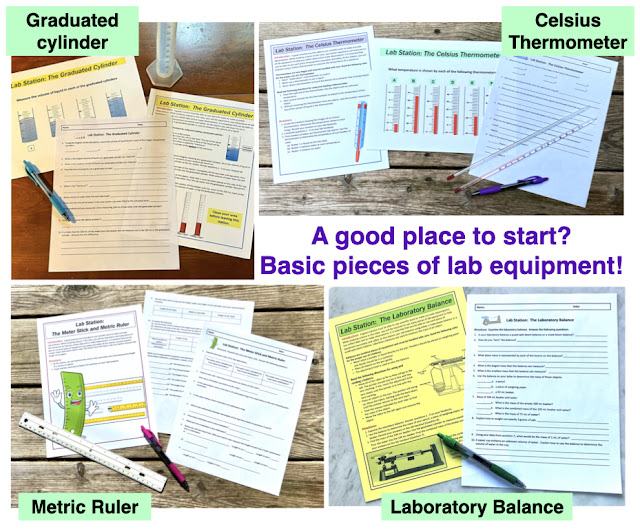
  • Use of basic pieces of lab equipment such as the graduated cylinder, Celsius thermometer, laboratory balance, and metric ruler.
  • Tabling, graphing, and analyzing data.
  • Math skills: Scientific notation, dimensional analysis, significant digits
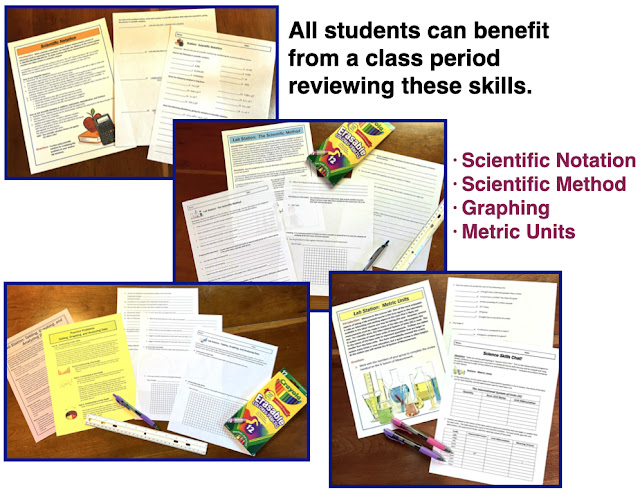
To accomplish this goal of proficiency of science skills, I have developed Science Skills Chat! -- a set of 17 Lab Stations to address 17 essential science skills all science students should know. I use the word "chat" to emphasize to my students that they are to work together and have a productive discussion at each station in order to maximize their understanding and mastery of the concepts being covered. 

Peer tutoring is a powerful learning tool!


Click on red text or any image to view Science Skills Chat in my TpT store.


What are the 17 Essential Science Skills?
  • Metric Units
  • Identification of Lab Equipment 
  • Scientific Notation
  • Dimensional Analysis
  • Significant Digits
  • The Scientific Method
  • Tabling, Graphing, and Analyzing Data
  • The Graduated Cylinder 
  • The Metric Ruler 
  • The Laboratory Balance 
  • The Celsius Thermometer 
  • The Bunsen Burner 
  • Determining the Volume of Solids 
  • Separating a Mixture 
  • Determining Density 
  • Accuracy, Precision, and Percentage Error
  • Scientific Drawings 


Don't try to complete all 17 lab stations at once. Choose a set of skills (perhaps 4 or 5 lab stations) to be completed during the first week of school. Choose the skills that are of immediate concern to you. Remember, some students may already be proficient in these skills, but other students will be struggling. No matter the ability level, ALL students will benefit from this review and reinforcement. 

Click on red text or any image to view Science Skills Chat in my TpT store.


Once your students have mastered the first set of skills that you deem most important, set up another lab station day to work on skills that students will soon need to know. 

I like the idea of having "Science Skills Friday" where you choose 4 or 5 lab stations to complete. The information in a fewer number of lab stations is not overwhelming, and it is a fun and different way to end the week. There are enough lab stations in Science Skills Chat to create several "Science Skills Friday" sessions.

Click on red text or any image to view Science Skills Chat in my TpT store.


Ten of the lab stations require some sort of lab equipment, but the other 7 skills are perfect activities to leave in your substitute teacher folder. In an emergency, your sub can grab a few of these and create a VERY quality lesson in your absence.

It may seem like you are spending a lot of time at the beginning of the year to cover these 17 science skills, but I guarantee that it is time well spent. As your school year progresses, you will spend far less time repeating and re-teaching skills that your students should already know.  

And, how nice would it be to reduce the number of questions you get every time you go to the lab?


P.S.  I have 11 Chat Lab Station Activities on a variety of topics.  You can view them all here:

👉 If you want a full overview of teaching science skills, read this post on essential science skills. 

Looking for a simple way to strengthen science vocabulary? My Biology Prefixes and Suffixes activity helps students decode unfamiliar scientific terms by breaking words into meaningful parts.


Science Graphing Activities: Why Students Need to Learn Graphing by Hand

Science graphing is one of the most important skills students develop in a science classroom. Graphing activities help students organize data, recognize patterns, and truly understand scientific results. In today’s classrooms, technology makes it easy to generate graphs instantly. Computers, graphing calculators, and probeware can collect data and produce graphs in seconds. While these tools are useful, students still need to learn how to create graphs themselves. Strong graphing skills in science also help students interpret graphs and analyze experimental data with confidence.

In my biology, chemistry, and AP Biology classes, I spend time during the first few days of school teaching students how to organize data, construct data tables, and graph results by hand. When students collect their own measurements and plot the data on graph paper, they begin to recognize patterns, relationships, and trends in a much deeper way.

Graphing is not just a math skill. It is one of the most important science process skills students can develop.

If you are interested in teaching other essential science skills, you may also enjoy reading about the five essential skills every science student should develop.

Why Graphing Is an Essential Science Skill

Graphs allow students to organize information, analyze data, and communicate scientific results clearly. When students graph their own data, they begin to understand how variables are related and how scientists interpret experimental results.

Graphing activities help students:

  • understand independent and dependent variables
  • reinforce x and y coordinate relationships
  • recognize patterns in experimental data
  • organize scientific information logically
  • draw meaningful conclusions from investigations
  • develop stronger critical thinking skills

These skills are foundational for scientific thinking and help students become better problem solvers.

Graphing by Hand vs. Using Technology

Many classrooms now rely heavily on digital tools to create graphs. Graphing calculators, spreadsheets, and probeware can quickly generate graphs from collected data. While these tools are helpful, they can sometimes make students passive participants in the learning process.

When technology automatically records data and produces a graph, students may not fully understand how the graph was created or what it represents.

However, when students graph data by hand they must:

  • choose an appropriate scale
  • label axes correctly
  • identify variables
  • plot data points carefully
  • interpret the pattern of the data

This process encourages students to think more deeply about the investigation and the meaning of the data they collected.

Why Graphing Skills Matter for Standardized Tests

Students may not always be asked to draw graphs on standardized tests like the ACT or SAT, but they are frequently required to interpret graphs and analyze data.

Students who understand how graphs are created are much better prepared to answer questions involving:

  • trends in scientific data
  • relationships between variables
  • interpretation of experimental results

Graphing is also commonly required on Advanced Placement science exams, especially in the free response sections where students analyze experimental data.

Developing strong graphing skills helps students become more confident when working with scientific data.

Science Graphing Practice Activities for Students

Students learn graphing best through practice. Structured graphing activities help students build confidence with data tables, scales, and interpreting results.

You can download a free graphing and data analysis worksheet here. This activity gives students practice organizing data and creating graphs from scientific information.

More Graphing Practice for Science Students

Once students understand the basics of graphing, they need continued opportunities to apply those skills throughout the year. These graphing practice problems are perfect for additional reinforcement.

You can also use Graphing and Data Analysis Practice Worksheets to help students graph experimental data, analyze patterns, and answer questions about scientific relationships.

You may also enjoy this enzyme graphing activity where students analyze enzyme reaction data and create graphs based on experimental results.

FAQ: Science Graphing in the Classroom

Why is graphing important in science?
Graphing helps students organize experimental data, identify patterns, and interpret relationships between variables. Creating graphs also helps students understand how scientists analyze and communicate results from investigations.

What types of graphs are used in science?
The most common graphs used in science classes are line graphs, bar graphs, and scatter plots. Line graphs are typically used to show change over time, while bar graphs compare categories of data.

Should students learn to graph by hand?
Yes. While technology can quickly generate graphs, learning to graph by hand helps students understand variables, scales, and patterns in data. This process strengthens critical thinking and scientific reasoning.

How can students practice graphing skills?
Students can practice graphing by collecting experimental data, organizing it in tables, and constructing graphs from the results. Graphing practice worksheets and lab activities also help students develop confidence with data analysis.

Graphing Is One of the Most Important Science Skills

Technology will continue to play an important role in science education, but students still need a strong foundation in data analysis. When students collect data, organize it into tables, and construct graphs themselves, they develop a deeper understanding of scientific investigations.

Graphing is not just about drawing lines on graph paper. It is about helping students think like scientists.

If you want to explore more strategies for teaching graphing skills in science, you may also enjoy these related posts:

Teaching Graphing Skills in Science

Graphing and the Scientific Method

Math Skills in Science Classrooms

👉 “If you want a full overview of teaching science skills, read this post on essential science skills.

Lab: Determining the Density of Unknown Metals


Click on picture to download this lab for free.


Here is a brand new FREEBIE for you!


I have a friend who is a newly starting science teacher in our local middle school.  She has many years of teaching experience, but is new to the wonderful world of science.  Due to all sorts of factors beyond her control, she has been teaching a science class this year.  The textbook being used is neither life science nor physical science, but a spiraling mix of both.

Most of you know me as a biology teacher, but in my 28 years of high school teaching, I have taught chemistry classes for at least 15 of those years.  This week end my friend needed help, so together we came up with this idea for a simple lab that she could do.

I have added this lab to my store on TeachersPayTeachers.com, but it is FREE for the taking.  I hope that it will benefit many of you.  Just click the link below to download.

Lab: Determining the Density of Unknown Metals

The materials list for this lab is simple:  a balance, a graduated cylinder, and different pieces of metal.  You can use any metals that you might have available.  Most middle and high school labs will have pieces of aluminum, copper, magnesium, lead, and zinc.  This lab will work with whatever you have available.

The idea is very simple.  Students will determine the mass and volume of the metal strips, and use this data to calculate the density.  The student does not know the identity of the metal.  From a list of densities provided, the student will determine the identity of each metal.  We added 12 analysis  and follow up questions that are thought provoking and require some critical thinking skills.  And since standardized testing is almost upon us, we added a graphing exercise (involving density) to reinforce the graphing skills that were taught earlier.  Here is a quick look at a few of the pages.  An answer key is provided with the download.


Enjoy this new freebie and Happy Teaching!

Also related:

New FREE Item: "Using a Graph to Find Area"


I recently realized that my students need a lot more extra practice on certain science skills:  Graphing, use of simple pieces of lab equipment, problem solving, critical thinking, interpolation and extrapolation.  I wrote this activity to cover all of these things.  


In this lab activity, I give each group of students 4 pieces of poster board of regular size.  Prior to the lab, I cut the poster board into different sizes and shapes.  The students use a ruler to determine the length and width of each regular-shaped piece.  They then determine the area of the piece of poster board.
A balance is used to determine the mass of each piece of poster board, and this data is placed on a graph.  The student should immediately see from the graph that there is a direct relationship between mass of the poster board and the area of the poster board.  When the four points are plotted on the graph, it should result in a straight line.


There is nothing amazing about this activity, but it does provide VALUABLE practice in graphing.  Next, comes the problem solving and critical thinking section of this lab.  Students are given a piece of poster board that is irregular in shape, and they are asked to determine the area of this oddly shaped piece of poster board.  The student easily determines the mass of the irregular piece.  Once the mass is known, the student will use their graph to determine the area.


The activity also includes follow up questions.  The student will use their graph to interpolate and extrapolate to determine the answer to a series of questions.


I am offering this activity to you for free.  I hope that you will enjoy using it with your students.


Happy Teaching!

Science Skills: Applying the Scientific Method


Teaching the “skills of science” is of the utmost importance.   I cannot stress this enough!  Yes, the "content of science" is important, but the content cannot be taught to our students until the skills are taught to our students. Scientific method, metric measurement, scientific notation, prefixes and suffixes, significant figures, compare/contrast, problem solving, critical thinking, dimensional analysis, proper use of lab equipment, scientific writing ... these are the skills I am referring to.  If the skills are taught properly at the beginning of the school year, your students will be equipped with the tools they need to be successful for the rest of the year.  Science is more than the memorization of a long list of facts.  Science is problem solving, analyzing, predicting and experimenting.  Make the teaching of basic science skills a priority in your class.

In a previous article, I talked about the importance of graphing skills.  Today, I want to talk about the importance of being able to apply the scientific method.  The key word here is...... apply.  You may be thinking, "I teach the scientific method every year during the first week of school."  Many teachers have their students write down the 5 or 6 steps to scientific method, define some keywords such as hypothesis, variable, and theory, re-state the 6 steps on a test, and .... DONE!  Time to move on to the next topic.  

We can do better than that.  Teaching our students how to apply the steps of the scientific method is not easy, and it takes up quite a bit of valuable class time.  We have to create lessons that teach the application of the scientific method, not lessons that teach the memorization of the scientific method.  

At the beginning of the school year we should give assignments that:
  • Reinforce graphing skills.
  • Teach students to interpret and analyze graphs.
  • Provide writing prompts to teach students how to design a controlled experiment.
  • Teach students to identify the independent and dependent variables in an experiment.
  • Teach students how to apply the scientific method to a particular scenario.
  • Give students practice in scientific writing.
Please get away from using only multiple choice, true and false, and matching questions.  I try as much as possible to have my students WRITE.  It is very time consuming to grade, but when students are asked "to design an experiment to show..." , you are teaching so many of the above skills.  And you are not just teaching the scientific method.  You are reinforcing critical thinking, problem solving, and best of all, good writing skills.

If you are just beginning to develop lessons on the scientific method, try my Scientific Method PowerPoint.  This is a 26 slide PowerPoint presentation on the nature of science and the scientific method.  The slides are colorful and visually appealing.  Steps of the scientific method are covered, but more importantly, the lesson provides examples and practice problems illustrating the application of the scientific method.  Analysis questions and answers are included.  The download also includes 4 pages of notes for the teacher and a 5 page outline of the notes for the student.  


Now take your students to the lab and see how well they can apply what they have learned about the scientific method.  My "
Can Your Students Write a Clear and Concise Procedure" is a great introduction into scientific writing. It's a fun activity that reveals to students the importance of accuracy and details when writing in science.  


Now you are ready to teaching students how to design and carry out a controlled experiment.  Start with this classroom activity (Applying the Scientific Method and Scientific Writing) involving hypothetical situations.  

Forge ahead with a student-designed lab activity:  The Scientific Method Lab. Students will plan and carryout the entire process from start to finish.  Full disclosure ... This takes time and quite a bit of patience, but it is worth it.  Your students will hone their problem solving and critical thinking skills as they complete these activities.