




You've just finished teaching the periodic table to your high school chemistry or physical science students. You've covered periods, groups, valence electrons, metals, nonmetals, and important periodic trends. You've explained atomic radius, electronegativity, and ionization energy, and you're feeling pretty good about how well your students understand the material. Surely they're ready for the unit test!
Then you notice a few glazed-over looks. Students can repeat the definitions, but can they actually apply what they've learned? It might be time for a periodic table review game that requires a little more thinking!
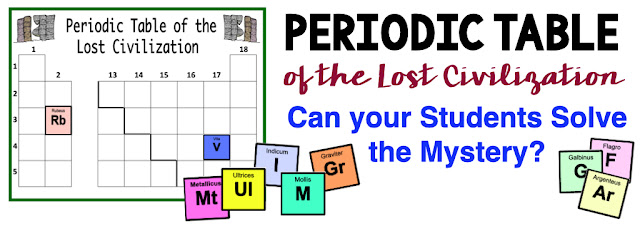
One of the best ways to determine whether students really understand a science concept is to ask them to apply their knowledge to an unfamiliar situation. That's exactly what students do in Periodic Table of the Lost Civilization, a mystery-based periodic table review activity that challenges students to reconstruct an ancient periodic table using clues about fictional elements and their properties.

A Periodic Table Mystery: The Lost Civilization
Here's the story! A long-lost civilization has been discovered buried beneath many feet of lava from an ancient volcanic eruption. The civilization was home to scientists who were just beginning to discover and identify the elements of the natural world. Unfortunately, the volcanic eruption destroyed their civilization before they could complete their periodic table.
These ancient scientists used different names and symbols for the elements than we use today. Students must take on the role of modern scientists and figure out how the ancient civilization organized its elements.
Students receive 28 clues describing 34 fictional elements. Each clue provides information about an element's chemical or physical properties, its position relative to other elements, or its behavior. Using their knowledge of periodic table organization and periodic trends, students determine where the elements belong on the lost civilization's periodic table.

Using Periodic Trends to Solve the Mystery
What I love about this periodic trends review activity is that students cannot complete it by simply memorizing vocabulary or copying information from a periodic table. They must understand how the periodic table is organized and use that knowledge to make decisions about where each element belongs.
For example, students must apply their understanding of groups and periods, valence electrons, electron energy levels, element reactivity, and the properties of metals, nonmetals, and metalloids. They also use periodic trends such as atomic radius, electronegativity, and ionization energy to recognize relationships among the fictional elements.
Here are a few examples of the clues students must interpret:
- The following elements are known to be unreactive: Scansio (S), Lumen (Lu), Graviter (Gr), Piger (Pi), and Respiro (Rp). The element Scansio (S) has 2 valence electrons.
- Flavus (Fa) is the most reactive of the nonmetals.
- The atomic radius of Lumen (Lu) is much smaller than the atomic radius of Respiro (Rp).
- Piger (Pi) has valence electrons in the third energy level.
Each clue requires students to think about what they already know. If an element is extremely reactive, where might it belong? What can its valence electrons tell them about its location? How can atomic radius help them determine which of two elements should be placed higher or lower in the same group?
Students work through the clues, compare information, eliminate incorrect possibilities, and gradually complete the ancient periodic table. As more elements fall into place, the patterns become clearer. I especially enjoy watching those light-bulb moments when students realize that a clue they couldn't solve earlier suddenly makes perfect sense!
More Than a Game: Periodic Table Review and Critical Thinking
Although students approach this as a mystery game, the real purpose is to strengthen their understanding of chemistry. Rather than answering isolated questions about periodic trends, they must use several concepts together to solve a larger problem.
The activity also includes 18 analysis questions that give students additional opportunities to explain their reasoning, interpret periodic trends, and demonstrate what they understand about the organization of the periodic table.
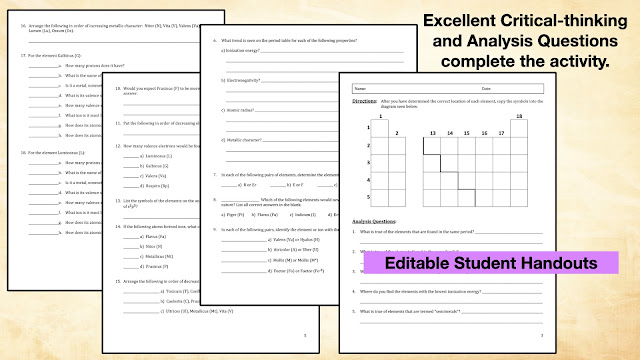
These questions are especially helpful when preparing students for a periodic table or periodic trends test. They provide another way to see whether students truly understand the relationships among elements rather than simply remembering a list of definitions.
Printable, Editable, and Digital Periodic Table Activity
I prefer having students work with printed materials whenever possible, particularly for an activity like this one. There is something satisfying about physically arranging the element squares, moving them around as new information becomes available, and finally seeing the completed periodic table take shape.
However, I also know that teachers need flexibility. This periodic table activity includes printable student materials, editable handouts, and a digital Google Slides version. In the digital activity, students drag and drop the fictional element squares into the correct positions on the ancient periodic table.
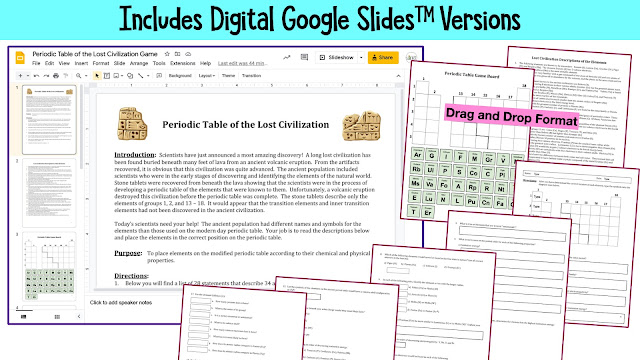
Whether students work with the printable element cards or the digital version, the goal remains the same: apply their chemistry knowledge to solve the mystery. The different formats make it easier to use the activity in a traditional classroom, with partners or small groups, or as an individual review assignment.
When to Use This Periodic Table Review Activity
I especially like using this activity after students have learned the structure of the periodic table and the major periodic trends. It makes an excellent review before a unit test because students must bring together information from several lessons and use it to solve a problem.
It also works well as a partner or small-group activity. Students can discuss the clues, explain their reasoning, and challenge one another's ideas as they decide where the elements belong.
For students who finish the mystery, the analysis questions provide a natural follow-up. Teachers can also use the activity as a cumulative review later in the course when students need to revisit periodic table organization and periodic trends.
Ready to Try the Periodic Table of the Lost Civilization?
If you're looking for a periodic table review game that gets students thinking, discussing, and applying their knowledge, I hope you'll give this one a try. It combines the challenge of a mystery with the important chemistry concepts students need to master before moving forward in the course.
The resource includes the ancient civilization storyline, 28 element clues, 34 fictional elements, the periodic table activity, 18 analysis questions, and printable, editable, and digital options. You can see the complete resource and preview the included materials in my TpT store.
View the Periodic Table Review Game and Periodic Trends Activity on Teachers Pay Teachers →
More High School Chemistry Teaching Ideas
If you're looking for more ways to help students connect chemistry concepts to real scientific thinking, you might also enjoy my flame test chemistry lab. It's one of my favorite hands-on activities for helping students understand electron energy levels, excited electrons, and why different elements produce characteristic flame colors.
Students also need a strong foundation in the mathematical skills used throughout chemistry. My post on chemistry math skills, scientific measurement, and problem solving explains common student difficulties and offers ideas for building the skills students need to succeed in their chemistry coursework.
No matter what chemistry topic you're teaching, I believe students learn best when they're given opportunities to think, investigate, and apply what they've learned. That's what makes activities like this so rewarding to use in the classroom.
Have fun teaching!
