I’m Amy Brown, a veteran high school biology and chemistry teacher, wife, and mom who understands the daily reality of lesson planning, grading, meetings, and everything in between. I know what it feels like to have too much to do and not enough time to do it.
After decades in the classroom, I’ve created rigorous, classroom-tested biology and chemistry resources that save you planning time while still delivering strong, meaningful science instruction. Every lab, activity, and lesson is designed to move students beyond memorization and into real scientific thinking.
If you want your students excited about science and thinking deeply without spending your entire weekend planning, you’re in the right place.
“I just love getting kids hooked on science.”
Showing posts with label digital resources. Show all posts
Showing posts with label digital resources. Show all posts
Returning to school after summer break is stressful in the best of times. I think we can all agree that this is pretty much the WORST of times and that this year's return to teaching will be unlike any other. We teachers have faced many challenges before, but the challenges before us now are unprecedented. Whether you will be teaching virtually, in-person, or somewhere in between, you will find yourself in need of digital resources to support your curriculum. The reality of teaching in the days of COVID-19 means that student absenteeism will fluctuate wildly, many parents may opt to keep their kids at home, or schools may be forced to close altogether. This puts you in the challenging position of not only teaching your core science material, but also teaching students about your chosen (or chosen for you ...) method of virtual instruction. This can be overwhelming. You need activities that support the technical instruction of your students as well as their science instruction.
When students arrive in your classroom this fall, either in person or virtually, will they all have the same set of skills in using GoogleApps?
The short answer is ... No. On the first day of class, just as our students have different graphing skills, or math skills, or writing skills, they will cover the spectrum in their ability to use Google Apps.
On that note, I am very excited to introduce a new tool in your teaching arsenal: Technology Chat for Google Apps! If you plan on utilizing GoogleDriveTM or GoogleClassroomTM this fall, this is a fantastic activity to set your students up for success by teaching them a basic set of skills for the Google Apps. Your students will learn how to create and share Docs, Slides, and Sheets as well as many of the features used to complete assignments in Google Apps.
If you are not familiar with my other "Chat" activities, they are highly collaborative in nature and allow students to work together while mastering new material. This activity is a little different in that students can complete it remotely, in-person, or in pairs. If you are meeting students face-to-face, I highly recommend using the activity in cooperative learning groups. Peer help and instruction is a valuable learning tool. Whatever your teaching situation, Technology Chat is an extremely flexible activity that will fit with any teaching situation.
While this activity won't cover everything Google has to offer, it is a great tool to create a baseline of knowledge in your classroom and hopefully give your students enough technical know-how to start the year off right.
Teachers always rise to face new challenges, and this school year will be no different. In these unprecedented times, I am excited to see the amazing ways our community serves our students and the highly innovative new solutions we put into place in our classrooms. I hope this activity is a helpful addition to your back-to-school instructional plan. I wish you all the very best of luck this fall.
Hello everyone! Wow, in just a few short weeks our teaching world has been rocked to the core. If you had told me months ago that we would be in this shape today, I would have thought you had lost your mind. Unprecedented school closures have all of us scratching our heads and trying to figure out how to get through just one day at a time. Both teachers and parents are scrambling to look for resources for our students that can be used digitally for distance learning. Since it looks like schools are going to closed for some time, it's "all hands on deck" as we deal with the problems of educating children remotely. So let me get right to it. The purpose of this post is to let you know about resources that are available for both teachers and parents in the world of "distance learning." The rest of this post will consist of clickable links to resources you might find helpful. First, I am working to convert the resources in my TpT store over to digital formats for use in Goggle Drive, Google Classroom, and/or Microsoft OneDrive. As resources are updated with the digital version, I will add them to the "already posted" printable listing on TpT. In short, this means that if you have purchased a resource from my TpT store, you will be able to download the resource again, at no extra cost, to receive the digital version if one becomes available. Full disclosure: Converting items to digital resources is time-consuming and tedious work. My resources will not magically appear in digital format overnight, but I will add them as fast as I am able.
Just a reminder: Do you know how to determine if a resource you have purchased on TpT has been updated? You will not get email notifications from TpT when resources are updated. You'll need to navigate to your "My Purchases" page on TpT and look for notifications that appear with any resources that have been updated. What items at Amy Brown Science have been updated with new digital formats?
I started with my free resources. The following resources have been updated. Each includes a detailed Teacher Guide to help you navigate the world of Google Drive. I have also included a QuickStart Guide for the experienced users. Click the images or red text below to grab these free distance learning resources:
Backyard Ecology: This ecology activity is perfect for laying the groundwork prior to your ecology unit. The questionnaire will get your students thinking about the ecology and environmental issues of your local community.
Monohybrid Mice! is great for Punnett Square practice. These problems are on a beginner level and a perfect way to introduce one-factor genetics problems to your students.
DNA Informational Text Reading: This reading is based on Watson and Crick's famous one-page article published in 1953 in Nature magazine, announcing their discovery of the structure of the DNA molecule. It comes with graphic organizers to help your students read and understand this classic scientific paper.
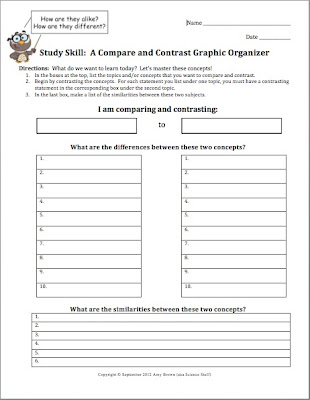
Compare and Contrast Graphic Organizer: This very simple, two-page graphic organizer has become one of the best study and review techniques that I use in my science classes. It forces students to think deeply about two topics or concepts as they search to find the similarities and differences between them.
Cell Respiration Word Game Review: This review activity is designed to help your students master the difficult vocabulary in a cell respiration unit.
I have also created a new custom category in my TpT store called "Digital / Google Apps" where you can find all of my digital resources. Clicking the link to this custom category will sort my store to show all of my digital resources. This is a great link to save. It will allow you to see if any of the resources you have previously purchased have been updated for Google Apps.
Let me ask a favor of you: Please respect my copyright by NOT posting my resources on a public web site where my resources can be accessed by a Google search and the public world. You are welcome to post to your own password-protected class site as long as only your students have access. Thanks so much for your understanding.
One more thing before I move on to other suggestions for resources: Signing up for my free newsletter is a good way to receive notifications for updates, exclusive freebies, promotions, sales, and news. Click this link if you are interested in my newsletter.
Okay, now I am going to post links to all sorts of things that I have seen over the last few weeks that I think might be helpful to you.
TpT School Access is a subscription-based service offered to schools. TpT is currently making School Access available for free (through June 30, 2020) to all schools impacted by the CoronaVirus. Click red link for more information.
Have you tried Boom Learning? Boom Cards are digital task cards, and a fantastic way to keep you students reviewing important content. Boom Learning is currently offering free memberships through June 30, 2020. You can find all of my Boom Card listings here.
This is not a new lesson, but I did want to remind everyone that I have a wonderful and PowerPoint on the scientific method. Students are going to groan and roll their eyes in complete boredom unless you do something to spice it up. Let's be honest, they have been hearing the steps of the scientific method over and over and over for as long as they can remember. I tried to make this lesson more interactive, and more engaging. The 27 slides are colorful and (hopefully) eye-catching. I have included a 4-page set of notes for the teacher, and a 5-page outline for the student. The student will fill in the missing information as the lesson is being taught. The printable lessons are perfect for traditional classroom settings, and the digital versions are perfect for distance learning and 1:1 classrooms.
And.....
.....the best part.....
This lesson takes the student beyond memorizing the steps of the scientific method......again! Problem solving scenarios are included that teach the student how to work through the scientific method to answer a question or solve a problem.
"Back to School" is just around the corner. I hope that you find these materials useful and beneficial to your students. It's definitely worth your while to make sure that your students are well grounded in the scientific method early in the school year. It is a skill they should use throughout the rest of the school year.
Here's a great new free item for your science classroom:
DNA Informational Text Reading with Graphic Organizers
I teach in a Common Core state, and in a school that is really pushing the implementation of the Common Core State Standards. We have to show evidence of this implementation in our classroom. I obviously have to do what is required of me by my admin, but at the same time, I do not want to lose valuable classroom teaching time and get behind on the vast amount of course content that I am also required to teach.
I recently developed this lesson for my students. In our unit on DNA, RNA, and Protein Synthesis, I love to tell the history of Watson and Crick and their discovery of the structure of the DNA molecule. In 1953, James Watson and Francis Crick rocked the scientific world with their discovery, and with the publication of their one-page paper in Science magazine describing the DNA molecule. This one-page paper is a marvelous bit of history, and it is a fascinating read. It is also a perfect piece of informational text that can be used to teach the Common Core State Standards.
The one-page article can be printed and used in your science classroom. I developed a 4-page set of graphic organizers to go along with this article. As students read the article they are required to complete the graphic organizers. You can have your students complete all four organizers (I usually do!) or each graphic organizer can be used alone. The printable lesson is perfect for traditional classroom settings, and the paperless, digital Google Apps version is perfect for distance learning and 1:1 classrooms.
You can, of course, use class time for this activity, but I usually assign this as a homework assignment. I assign this at the beginning of my unit on DNA, and usually give a week to complete the assignment. The article and the graphic organizers provide great review on the topics I am teaching in class, as well as a lesson in the reading of informational text. It's a win-win! (Pssst...This is also a great activity to leave in your sub folder in the event of your unexpected absence from school!)
Here is a look at each of the graphic organizers:
(They look best if printed in color, but print perfectly fine in grayscale.)
This is a free download, and will always remain a free download. Enjoy!
Task cards are a fantastic way to reinforce lessons, review
difficult concepts, or provide extra practice for the struggling student.The student reads each card, performs the
task, and records his/her answer on an answer sheet, on notebook paper, or in their lab notebook.
There are many
ways to use the task cards.
As seen in the photo above, punch a hole
in the corner and place them on a ring.Hang them on a pegboard for use throughout the year.When reviewing for tests or exams, students
can select the set of cards from the pegboard for the topic that needs the most
review.
Set up a practice/review session by setting
the cards up in a lab practical style.Place one card at each station and have the students rotate through the
stations until all stations have been completed.My students love this format since it allows
them to move about the room.The task cards
in this format are a great way to give a quiz or test.
Use the cards in a game format.Divide the class into teams.Place the task cards face down in a
basket.A team selects a card at random and
must complete the task for a point.
Students can use a set of task cards in
small groups and orally review one another for a unit test.
The task cards seen in the photo above are on the scientific method. The face of science teaching is changing.Common Core Science Standards, as well as the
Next Generation Science Standards, are asking teachers to emphasis scientific
concepts, rather than the memorization of large amounts of factual data.Instrumental to these new standards is
teaching the student how to design and implement an experiment of their
own.The first step in teaching the
student-designed experiment is to provide the student with a complete and
thorough understanding of the scientific method.
Most of the students entering my biology classes at the beginning of the school year can (in a very bored and monotone voice) recite the steps to the scientific method. What we as teachers need to insure is that the student can actually APPLY the scientific method.
Can the student read a passage and determine the independent and the dependent variables in the experiment?
Can the student identify the control and explain WHY it is the control?
Can the student look at a set of data and draw a logical conclusion?
Can the student design and implement an experiment?
The printable task cards are perfect for traditional classroom settings, and the paperless, digital Google Apps version is perfect for distance learning and 1:1 classrooms.
I have a PowerPoint and set of notes that you can use as a starting point in your teaching of the scientific method. This product can be viewed and downloaded here. Once your instruction is complete, you might want to give these task cards a try. I most often use the cards in a lab practical format. Students rotate through the various stations and complete the task at each. The set includes 45 task cards. Some of the "tasks" include:
Writing a hypothesis.
Distinguishing between the experimental and control groups
Identifying the independent and dependent variables.
Drawing a conclusion based on given data.
Be sure to follow up your lessons on the scientific method by having your students design and implement an experiment of their own. You can check out my blog post on student designed experiments by clicking here.
Do you want to do a great genetics lab with your students, but don't have time for fruit flies?
Having enough "time" is an issue for me every single year! I finally had to come to the realization that my fruit fly genetics lab would have to go. It is such a great lab, but just too time consuming.
Now we grow corn! It only takes a few minutes to plant and you are practically done! I do have my students water their corn every few days, and in about 2 weeks we are ready to do the lab.
In corn, green stem (due to chlorophyll production) is dominant over albino stem. I order seeds that are the F-2 offspring of heterozygous parents. The expected ratio when the seeds grow is, of course, 3/4 green stem and 1/4 albino stem. Students then compare the expected ratios to the actual number of each type of offspring observed.
For an added component to the lab, have the students consider the effect of the environment on the expression of the gene. When the seeds are first planted, I have half the class place their trays on a table in front of a window. The other half of the class place their trays in a cabinet in complete darkness. When the seeds finally sprout and grow, we compare the number of albinos grown in the dark to the number of albinos grown in the light.
For those plants grown in the light, the results are fairly close to the expected 3:1 ratio. But, the seeds grown in the dark are a different story. 100% of the seeds grown in the dark turn out to be albino.
After this first observation, all trays are left in the light for 48 hours, and a second observation is made two days later. Miraculously : ) about 3/4's of the albinos from the dark trays have now turned green.
Students quickly determine that the environment plays a very important role in gene expression.
If you choose, you can order seeds showing two traits as seen in the photo to the left. When these seeds were grown, students could determine the expected and actual numbers of green and albino stems as well as the number of tall and dwarf plants.
You can view this lab in my TpT store by clicking this link:
👉 Check this Blog Post: For additional reinforcement of Mendelian genetics concepts, students can practice with this monohybrid genetics worksheet that focuses on Punnett squares and dominant and recessive traits.
Short daily practice activities can help reinforce genetics vocabulary and problem solving skills. These genetics warm ups provide quick review questions that build student confidence with concepts like dominant and recessive traits, Punnett squares, and inheritance patterns.
Free Monohybrid Cross Worksheet for Punnett Square Practice
This free monohybrid cross worksheet with Punnett squares is one of the best ways to help middle and high school biology students apply what they have learned about dominant and recessive traits. In this worksheet, students practice setting up Punnett squares, identifying genotypes and phenotypes, and analyzing simple one-trait crosses using familiar human traits. After years of teaching genetics, I have found that students are naturally curious about traits like widow’s peak, hitchhiker’s thumb, crooked little finger, and even tongue rolling. That curiosity makes monohybrid crosses one of the most engaging and accessible starting points in any genetics unit.
What is a Monohybrid Cross?
A monohybrid cross is a genetics problem that examines the inheritance of one trait using a Punnett square. In a monohybrid cross, students analyze how dominant and recessive alleles combine to produce different genotype and phenotype ratios in the offspring.
Why Monohybrid Genetics Starts with Mendel
Thanks to the work of Gregor Mendel, the study of genetics began in an abbey garden in the mid-1800s. Through years of careful breeding of pea plants, Mendel established the basic laws of inheritance that biology teachers still rely on today. His work provides the foundation for understanding how traits are passed from parents to offspring and why predictable patterns appear in genetics problems.
Nearly every middle and high school biology genetics unit begins with Mendel’s story. From his experiments, students learn essential genetics vocabulary such as trait, gene, allele, dominant, recessive, homozygous, heterozygous, genotype, phenotype, and segregation. Once these terms are introduced, instruction quickly moves to Punnett squares and probability.
The Real Challenge with Teaching Punnett Squares
For many biology teachers, this is where instruction can become frustrating. The issue is rarely that genetics is too difficult or that students cannot understand Punnett squares. Instead, the problem is a lack of meaningful practice. Many biology textbooks provide only a few genetics problems, which is not enough for students to build confidence with monohybrid crosses.
After many years in the biology classroom, I have learned that students need repeated, structured practice with simple one-factor crosses before moving on to more advanced genetics topics. That need is exactly why I created this resource.
Free Monohybrid Genetics Practice Worksheet (Punnett Squares)
One of my most used resources is Monohybrid Mice, a free monohybrid genetics practice worksheet designed to reinforce Punnett squares. Before students attempt dihybrid crosses or more complex inheritance patterns, they must be comfortable completing a basic monohybrid cross.
This free worksheet includes four carefully designed problems. Students complete a Punnett square, record genotypes and phenotypes, calculate probabilities, and answer follow-up questions that check for understanding. All problems focus on mouse coat color, which keeps the practice consistent and easy to follow while students focus on the genetics rather than decoding new traits.
These Monohybrid Mice practice problems focus on coat color inheritance and give students clear, structured Punnett square practice.
Printable and Digital Options for Any Classroom
This genetics practice resource includes both a printable version for traditional classrooms and a digital Google Apps version for paperless instruction. It works well in middle school and high school biology classes, 1:1 classrooms, and distance learning environments.
Once students master monohybrid crosses, they are usually ready to move on to more complex genetics topics such as dihybrid crosses and non-Mendelian inheritance patterns.
Looking for a Complete Genetics Teaching Unit?
If you need a ready-to-use genetics and heredity unit for high school biology, my complete Genetics Teaching Unit includes everything you need to teach this topic with confidence. This comprehensive unit features a PowerPoint with student-friendly notes, hands-on labs, practice worksheets, review games, quizzes, and a full unit test. It is designed to save you planning time while giving students multiple opportunities to master genetics concepts.
👉 Click here to view the complete Genetics and Heredity Unit on Teachers Pay Teachers.
Extend Learning with More Genetics Practice
Once students have mastered monohybrid crosses, they are ready to move on to more complex inheritance patterns. Related genetics resources that pair well with this free practice include:
More Genetics Activities for Your Biology Classroom
If you are looking for additional ways to help students master genetics concepts, these blog posts on related activities provide more opportunities for practice with Punnett squares, inheritance patterns, and gene expression.
Punnett Square Hidden Picture Activity Students love reviewing genetics concepts with this engaging hidden picture reveal activity. As students solve Punnett square problems correctly, a hidden image is gradually revealed, making practice both interactive and motivating. 👉Read blog post here:
Genetics Warm Ups and Bell Ringers Short daily practice activities can help reinforce genetics vocabulary and problem solving skills. These genetics warm ups provide quick review questions that build student confidence with concepts like dominant and recessive traits, Punnett squares, and inheritance patterns. 👉 Read about it here:
Environmental Influences on Gene Expression Lab This hands-on genetics lab explores how environmental factors can influence gene expression. Students investigate how conditions affect traits, helping them understand that genetics involves more than simple dominant and recessive inheritance. 👉 Read about this lab here:
Genetics in the Laboratory If you want students to experience genetics through real investigation, this classroom lab provides an engaging way to explore inheritance patterns and reinforce core genetics concepts. 👉 Read about the lab activity here:
Enjoy the freebie, and best of luck with your genetics unit.
With the increasing amount of information that our students are expected to learn and master, it is more important than ever to provide them with the tools they need to organize and study difficult concepts. This free graphic organizer can help your students learn to delve deeper into the content to search for similarities and differences between two topics or concepts.
Click image for free download.
This can be used in all subject areas and in grades 4 and up. My students even admit that this technique has improved the way they view the content that we cover each day. The graphic organizer can be used to compare and contrast any two topics or concepts. I have used this organizer to have my students compare and contrast:
Photosynthesis to cellular respiration
Mitosis to meiosis
Protostomes to deuterostomes
Vascular plants to nonvascular plants
Systems of the body
DNA to RNA
The printable version is perfect for traditional classroom settings, and the paperless, digital Google Apps version is perfect for distance learning and 1:1 classrooms.
You can download this free graphic organizer by clicking on any of the above pictures, or on this link: