
menu Home About Me Home Freebies My Store
Amy Brown Science Facebook    Amy Brown Science Instagram    Amy Brown Science Pinterest    Amy Brown Science Teachers Pay Teachers    Email Amy Brown Science

Search My Blog

Real Science Teaching. Real Classroom Experience.

I’m Amy Brown, a veteran high school biology and chemistry teacher, wife, and mom who understands the daily reality of lesson planning, grading, meetings, and everything in between. I know what it feels like to have too much to do and not enough time to do it.

After decades in the classroom, I’ve created rigorous, classroom-tested biology and chemistry resources that save you planning time while still delivering strong, meaningful science instruction. Every lab, activity, and lesson is designed to move students beyond memorization and into real scientific thinking.

If you want your students excited about science and thinking deeply without spending your entire weekend planning, you’re in the right place.

Amy Brown Biology and Chemistry Teacher

“I just love getting kids hooked on science.”

17 Essential Science Skills All Students Should Master


Do your students ask you questions like these?

  • Which one of these things is the graduated cylinder?
  • How do I convert from decimeters to decameters?
  • I can't do scientific notation on my calculator.
  • What are independent and dependent variables and how do I put them on a graph?
  • You wanted the graph to be on graph paper?
  • I did measure exactly 5 grams of salt on my balance! ( ... with salt in a beaker that wasn't massed.)
  • What do I do next?

Sound familiar? If you teach middle or high school science, these are probably questions you’ve heard a thousand times. And if you’re anything like me, you're always looking for ways to build essential science skills early in the year—so your students are more confident, independent, and lab-ready.

That’s exactly why I created these 17 Essential Science Skills Stations—hands-on, low-prep, and perfect for reinforcing key science lab skills across biology, chemistry, physical science, or general science classes.

🧪 “I used these during the first two weeks of school, and my students were so much more confident during our first full lab! Total game-changer.” – Melissa B., HS Biology Teacher

What are the essential science skills?
In the first days and weeks of a new school year, I need my students to be proficient in the following:
  • Metric measurement
  • Identification of pieces of lab equipment
  • Scientific method
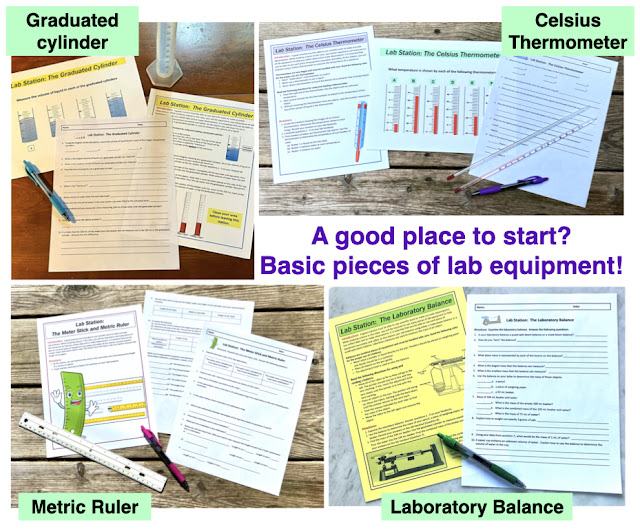
  • Use of basic pieces of lab equipment such as the graduated cylinder, Celsius thermometer, laboratory balance, and metric ruler.
  • Tabling, graphing, and analyzing data.
  • Math skills: Scientific notation, dimensional analysis, significant digits
To accomplish this goal of proficiency of science skills, I have developed Science Skills Chat! -- a set of 17 Lab Stations to address 17 essential science skills all science students should know. I use the word "chat" to emphasize to my students that they are to work together and have a productive discussion at each station in order to maximize their understanding and mastery of the concepts being covered. 

Peer tutoring is a powerful learning tool!
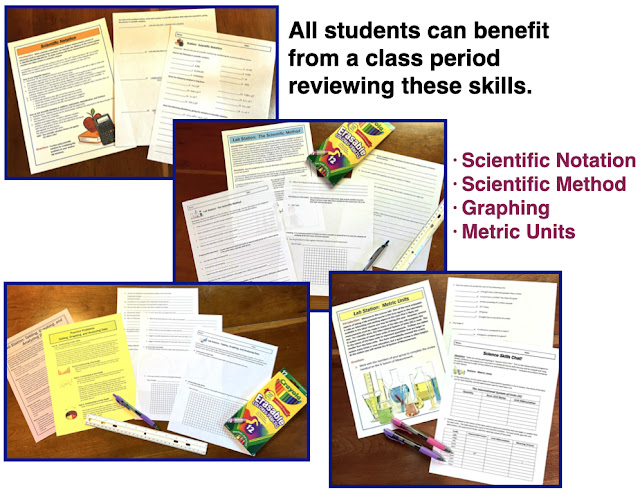

Click on red text or any image to view Science Skills Chat in my TpT store.


What are the 17 Essential Science Skills?
  • Metric Units
  • Identification of Lab Equipment 
  • Scientific Notation
  • Dimensional Analysis
  • Significant Digits
  • The Scientific Method
  • Tabling, Graphing, and Analyzing Data
  • The Graduated Cylinder 
  • The Metric Ruler 
  • The Laboratory Balance 
  • The Celsius Thermometer 
  • The Bunsen Burner 
  • Determining the Volume of Solids 
  • Separating a Mixture 
  • Determining Density 
  • Accuracy, Precision, and Percentage Error
  • Scientific Drawings 


Don't try to complete all 17 lab stations at once. Choose a set of skills (perhaps 4 or 5 lab stations) to be completed during the first week of school. Choose the skills that are of immediate concern to you. Remember, some students may already be proficient in these skills, but other students will be struggling. No matter the ability level, ALL students will benefit from this review and reinforcement. 
Click on red text or any image to view Science Skills Chat in my TpT store.


Once your students have mastered the first set of skills that you deem most important, set up another lab station day to work on skills that students will soon need to know. 

I like the idea of having "Science Skills Friday" where you choose 4 or 5 lab stations to complete. The information in a fewer number of lab stations is not overwhelming, and it is a fun and different way to end the week. There are enough lab stations in Science Skills Chat to create several "Science Skills Friday" sessions.

Click on red text or any image to view Science Skills Chat in my TpT store.


Ten of the lab stations require some sort of lab equipment, but the other 7 skills are perfect activities to leave in your substitute teacher folder. In an emergency, your sub can grab a few of these and create a VERY quality lesson in your absence.

It may seem like you are spending a lot of time at the beginning of the year to cover these 17 science skills, but I guarantee that it is time well spent. As your school year progresses, you will spend far less time repeating and re-teaching skills that your students should already know.  

And, how nice would it be to reduce the number of questions you get every time you go to the lab?


P.S.  I have 11 Chat Lab Station Activities on a variety of topics.  You can view them all here:


Technology Chat: Make Sure Your Students Are Ready for Digital Learning


Returning to school after summer break is stressful in the best of times.  I think we can all agree that this is pretty much the WORST of times and that this year's return to teaching will be unlike any other.  We teachers have faced many challenges before, but the challenges before us now are unprecedented.  Whether you will be teaching virtually, in-person, or somewhere in between, you will find yourself in need of digital resources to support your curriculum.  The reality of teaching in the days of COVID-19 means that student absenteeism will fluctuate wildly, many parents may opt to keep their kids at home, or schools may be forced to close altogether.  This puts you in the challenging position of not only teaching your core science material, but also teaching students about your chosen (or chosen for you ...) method of virtual instruction.  This can be overwhelming.  You need activities that support the technical instruction of your students as well as their science instruction.


When students arrive in your classroom this fall, either in person or virtually, will they all have the same set of skills in using Google Apps?

The short answer is ... No.  On the first day of class, just as our students have different graphing skills, or math skills, or writing skills, they will cover the spectrum in their ability to use Google Apps.
On that note, I am very excited to introduce a new tool in your teaching arsenal:  Technology Chat for Google Apps!  If you plan on utilizing Google DriveTM or Google ClassroomTM this fall, this is a fantastic activity to set your students up for success by teaching them a basic set of skills for the Google Apps.  Your students will learn how to create and share Docs, Slides, and Sheets as well as many of the features used to complete assignments in Google Apps.

If you are not familiar with my other "Chat" activities, they are highly collaborative in nature and allow students to work together while mastering new material.  This activity is a little different in that students can complete it remotely, in-person, or in pairs.  If you are meeting students face-to-face, I highly recommend using the activity in cooperative learning groups.  Peer help and instruction is a valuable learning tool.  Whatever your teaching situation, Technology Chat is an extremely flexible activity that will fit with any teaching situation.


While this activity won't cover everything Google has to offer, it is a great tool to create a baseline of knowledge in your classroom and hopefully give your students enough technical know-how to start the year off right.

Teachers always rise to face new challenges, and this school year will be no different. In these unprecedented times, I am excited to see the amazing ways our community serves our students and the highly innovative new solutions we put into place in our classrooms.  I hope this activity is a helpful addition to your back-to-school instructional plan.  I wish you all the very best of luck this fall.

Going Digital in the Age of Distance Learning


Hello everyone!  Wow, in just a few short weeks our teaching world has been rocked to the core.  If you had told me months ago that we would be in this shape today, I would have thought you had lost your mind. Unprecedented school closures have all of us scratching our heads and trying to figure out how to get through just one day at a time.  Both teachers and parents are scrambling to look for resources for our students that can be used digitally for distance learning.  Since it looks like schools are going to closed for some time, it's "all hands on deck" as we deal with the problems of educating children remotely.  

So let me get right to it.  The purpose of this post is to let you know about resources that are available for both teachers and parents in the world of "distance learning."  The rest of this post will consist of clickable links to resources you might find helpful.

First, I am working to convert the resources in my TpT store over to digital formats for use in Goggle Drive, Google Classroom, and/or Microsoft OneDrive.  As resources are updated with the digital version, I will add them to the "already posted" printable listing on TpT.  In short, this means that if you have purchased a resource from my TpT store, you will be able to download the resource again, at no extra cost, to receive the digital version if one becomes available.  Full disclosure: Converting items to digital resources is time-consuming and tedious work. My resources will not magically appear in digital format overnight, but I will add them as fast as I am able.


Just a reminder:  Do you know how to determine if a resource you have purchased on TpT has been updated? You will not get email notifications from TpT when resources are updated. You'll need to navigate to your "My Purchases" page on TpT and look for notifications that appear with any resources that have been updated.

What items at Amy Brown Science have been updated with new digital formats?
I started with my free resources.  The following resources have been updated. Each includes a detailed Teacher Guide to help you navigate the world of Google Drive.  I have also included a QuickStart Guide for the experienced users.  Click the images or red text below to grab these free distance learning resources:


Backyard Ecology:  This ecology activity is perfect for laying the groundwork prior to your ecology unit. The questionnaire will get your students thinking about the ecology and environmental issues of your local community.


Monohybrid Mice! is great for Punnett Square practice.  These problems are on a beginner level and a perfect way to introduce one-factor genetics problems to your students.


DNA Informational Text ReadingThis reading is based on Watson and Crick's famous one-page article published in 1953 in Nature magazine, announcing their discovery of the structure of the DNA molecule. It comes with graphic organizers to help your students read and understand this classic scientific paper.


Compare and Contrast Graphic OrganizerThis very simple, two-page graphic organizer has become one of the best study and review techniques that I use in my science classes. It forces students to think deeply about two topics or concepts as they search to find the similarities and differences between them. 


Cell Respiration Word Game ReviewThis review activity is designed to help your students master the difficult vocabulary in a cell respiration unit. 


I have also created a new custom category in my TpT store called "Digital / Google Apps" where you can find all of my digital resources. Clicking the link to this custom category will sort my store to show all of my digital resources. This is a great link to save.  It will allow you to see if any of the resources you have previously purchased have been updated for Google Apps.

Let me ask a favor of you: Please respect my copyright by NOT posting my resources on a public web site where my resources can be accessed by a Google search and the public world.  You are welcome to post to your own password-protected class site as long as only your students have access.  Thanks so much for your understanding.

One more thing before I move on to other suggestions for resources:  Signing up for my free newsletter is a good way to receive notifications for updates, exclusive freebies, promotions, sales, and news.  Click this link if you are interested in my newsletter.

Okay, now I am going to post links to all sorts of things that I have seen over the last few weeks that I think might be helpful to you.


Please note: All online learning sites should be throughly vetted by teachers and parents before allowing access to your students.

I hope that this post gives you some places to start as you begin your journey into distance learning.  Good luck to you, and please stay well!

P.S. The adorable "Dot Dudes" in the heading image are the copyrighted work of Sarah Pecorino Illustration.

Biochemistry Lab: Testing Foods for Organic Compounds.


What types of organic compounds are contained in the foods we eat? Sometimes an old idea is still the best way to teach a concept.  That is how I feel about this lab, "Testing Foods for Organic Compounds."  I have been doing this lab for over 30 years, and I never tire of doing it.  Granted, it is a bit messy and the observed results are sometimes a little subjective, but my students always love these two days in the lab.

This lab is best used during your units on Biochemistry and the Organic Compounds.  Teaching the characteristics of carbohydrates, proteins, and lipids can be dry and tiresome to students, and this lab is a great way to break the monotony of lecturing on these topics.  This lab activity is a two-part activity.  First, students will learn the indicator tests for sugars, starches, proteins, fats, vitamin C, and salt using known solutions.  Once the students understand how to complete these tests, they will test a wide variety of foods to see what compounds are contained in each food.

Before any testing of foods is carried out, students must "practice" to learn the indicator test for each compound.  For example, in order to determine if milk contains simple sugars, students must know how to carry out the test for simple sugars.  This is the purpose of the first part of the lab.  Students are given known solutions so that they can see what the positive test for a particular compound looks like.  Then, when the foods are tested, the students will recognize and understand the results they are getting.  Students will learn the positive and negative tests for the following:


  • Students will test for starch using iodine.
  • Students will test for simple sugars using Benedict's solution.
  • Students will test for proteins using Biuret reagent.
  • Students will test for lipids using the brown paper test.
  • Students will test for the presence of vitamin C using indophenol.
  • Students will test for salt using silver nitrate.
Please note: Obviously, salt is not an organic compound.  However, it is a fun test for the students to carry out, and it provides interesting information about the foods we eat.

Once students know how to use the above indicators, the real fun can begin! Choose a variety of foods that you would like for your students to test.  While you can theoretically use any foods in the experiment, some are easier to test than others.  For example, students will probably be frustrated if you ask them to test dark purple grape juice.  They simply will not be able to see the results of the tests.  I have the best results when testing the following:  Milk, yogurt, egg whites, egg yolks, potatoes, celery, cereals, and an assortment of fruit juices.  The liquid foods can be used straight from their containers.  For solids foods, you will need to prepare a solution of the food using a blender.

What are the benefits of doing this lab?
  • First and foremost, it is just plain FUN!  If students love your lab activities, they will be excited about your class.  These days, having your students excited about your class solves a host of other problems.
  • This lab reviews and reinforces the concepts you have been teaching in your classroom.  Facts about the macromolecules are easier to learn and remember when the students see a practical application of the information.
  • This lab teaches good lab techniques, how to organize data, and how to work in cooperative learning groups.
  • Students lean that a particular food that they thought was "healthy" is really nothing more than sugar and salt.
  • Working through detailed lab procedures teaches a student to read, understand, and follow directions.
  • Students must use their critical thinking and problem solving skills.

Below you can see the lab handouts that I use with my students.  Clicking here or on the image below will lead you to this lab in my TpT store. Complete teacher guide is included that contains an answer key to all questions, directions for preparing the solutions, and tips and suggestions for the successful completion of this lab activity.  


Book Review and Giveaway: "Awesome Physics Experiments for Kids"


It's not often that I do a product review.  And since you are now reading a product review, that should tell you that I am super-excited about this product!  Erica Colon (NittyGrittyScience.com) has written a fabulous set of experiments for young budding scientists, ages 10 to 13.  But this is more than just another science experiment book.  This is a book for parents and for families, and also a fantastic resource for science teachers.

Let's start with parents and families.  All of the experiments in this book can be carried out with simple materials, and anyone can do them!  No science background is required because Erica has included every single thing you need.  Here's what you'll find with each experiment:

  • Title
  • Problem or Question
  • Level of Difficulty (Easy, Medium, Difficult)
  • Time Suggestion
  • Materials List
  • The Steps
  • Now Try This!
  • The Hows and Whys
All parents will be able to do these experiments with their kids.  The procedural steps are clear and concise, and the final section is a life-saver if your background is not in science.  "The Hows and Whys" section will ensure that you can discuss these concepts with your children.

Now, let me speak to science teachers:  While these experiments were written for children of ages 10 to 13, these activities can easily be used as experiments and/or demonstrations from middle school classes up through high school physics classes.  What a relief to find activities that don't require expensive lab equipment!  And, if you love stem challenges, this book is perfect for you! And one more thing:  The activities are aligned with NGSS standards.

Here's a sample experiment that you can start using right away:


In addition to 40 super science experiments, Erica has included a Glossary of terms, Measurement conversions, Resources for kids, Resources for teachers, Blank tables and graphing grids, and an Index.

The book is being released through Amazon.  Click this link to view on Amazon.


Geologic Time Scale Worksheet and Activity for Teaching Evolution

Completed geologic time scale worksheet and classroom activity used in a biology class to visualize Earth’s history and evolution.

Teaching evolution and the history of life on Earth can feel overwhelming when class time is limited. This geologic time scale worksheet and classroom activity helps biology students visualize Earth’s history while reinforcing key concepts related to evolution, fossils, and major events in geologic time. Designed for upper middle school and high school science classes, this resource allows teachers to cover the geologic time scale efficiently without spending weeks on the topic.

If you are looking for a ready-to-use geologic time scale worksheet and classroom activity, you can find the resource I use with my students in my Teachers Pay Teachers store here.

Why Geologic Time Matters in Biology

The concept of geologic time and the appearance and evolution of life on Earth is VERY important to my class. One of my most favorite sayings, "Nothing in Biology makes sense except in the light of evolution" (Theodosius Dobzhansky, American Biology Teacher1973.) is a mantra in my classes. We can't teach cellular respiration without the concept of endosymbiosis, and we can't teach endosymbiosis until our students know the differences between prokaryotic and eukaryotic cells, etc, etc, etc. The history of life on Earth is (or should be!) woven into every single lesson we teach in a Biology class.

Then "What's the problem?" you might be asking yourself. My problem is time. Not geologic time;  just time to teach. It is a struggle to cover everything in a year that needs to be covered! My solution was to find a way to quickly cover the concepts of geologic time and the evolution of life on Earth, without taking weeks to do so.

Here are my goals.  I want my students to:
  • Know what is meant by the term "geologic time scale."
  • Be able to visualize the enormity of geologic time.
  • Know when life first appeared on Earth.
  • Know the order in which various life forms appeared.
  • Know the importance of fossils, especially traditional fossils, to the study of evolution.
  • Understand how scientists are able to date fossils that are found in various rock strata.
  • Understand the relationship between mass extinctions and adaptive radiations.
  • Have a clear and concise understanding of what happens in each era of Earth's history.
I am extremely pleased with the Geologic Time Scale activity I put together to accomplish these goals. This resource can be used in conjunction with your other lessons and materials you use on this topic, OR, (and here is the best part!) it can be used as a stand-alone activity that quickly covers the above topics in just a couple of class periods.  The printable worksheet is perfect for traditional classroom settings, and the resource is also available in a digital Google Slides version for 1:1 classrooms, distance learning, and Google Classroom use.

If you need to teach this fast, this is the activity for you!

How to Use This Geologic Time Scale Worksheet in the Classroom

  • Use the geologic time scale worksheet as a guided activity to reinforce the concepts of Earth’s history and the evolution of life.

  • Assign the worksheet as independent practice or small group work to reinforce the order of geologic eras and major evolutionary events.

  • Have students reference the included geologic time scale table to answer problem solving and analysis questions.

  • Use the activity as a review lesson before starting or assessing an evolution unit.


Geologic time scale reference table and student worksheet page shown with classroom materials such as scissors, tape, and paper pieces used for a cut-and-paste activity.

What concepts are covered in this resource?

  • Definition of the geologic time scale.
  • How the geologic time scale was developed by scientists.
  • Relative dating and radioactive dating.
  • Earth’s history is divided into 4 Eras which are subdivided into smaller periods.
  • How to read the information on the geologic time scale reference table.
  • Comparing lengths of geologic time.
  • The order of events in the evolution of life on Earth.
  • Transitional fossils.
  • Estimating the age of organisms based on relative dating.
  • Rock strata.

Photo of multiple geologic time scale worksheet pages used by students to explore Earth’s history and evolution.

What will the students be doing?

  • Students complete a 6-page handout on the geologic time scale and complete a 2-page timeline of the history of life on Earth.
  • Students make a circle graph of the time spent in each era.
  • Students use the included Geologic Time Scale Reference Table to answer a series of 30 problem solving questions.
  • Students make a scale diagram showing the length of each era.
  • Students look at pictures to evaluate characteristics of certain organisms.
  • Students complete a relative dating cut and paste activity.
  • Students using relative dating to estimate the age of certain organisms.
  • Students complete a 2-page cut and paste timeline activity showing the evolution of life on Earth.
  • Students are guided through an exercise that allows them to compare all of Earth’s history to one calendar year.
Geologic time scale reference table used by students to identify major eras, periods, and events in Earth’s history.

As much as I love teaching these topics, there is a limit to what we can expect our students to absorb. We can't ask them to learn every event in every era, period, and epoch in geologic time. I have certain key events that I want my students to know, so I put together a one-page table outlining the most important events in Earth's history.
  

The beauty of this resource is that with this one-page reference table the activity can be used as a stand-alone lesson. The students don't need prior knowledge or prior teaching. This lesson can be completed in two 1-hour class periods right before you begin your units on evolution. I would suggest having a biology textbook handy if students are seeing this information for the first time. There may be a few vocabulary words that they would need to look up.

If you are in a big time crunch, let the students work in groups for one class period, and complete unfinished portions for homework.


Geologic time scale worksheet shown before and after completion, illustrating how students organize information about Earth’s history and evolution.


You can find this activity in my TpT store by clicking this link, and here is what you can expect to find included:

  • 6-Page printable and editable student worksheet set
  • 1-Page Geologic Time Scale Reference Table
  • 2-Page Timeline Worksheet
  • 8-Page Teacher Guide and Answer Keys
  • All images needed for the "cut and paste" portions of the activity.
  • Paperless digital Google Slides version for use with Google Drive and Google Classroom.
Overview image showing all eight pages of the geologic time scale worksheet and activity used to teach Earth’s history and evolution.

I hope this article has given you something to think about, and some new ideas on how to teach geologic time to your biology or life science students. Have fun teaching!

Returning to Your Lab After Summer Break: A "Must-Do" List of Chores


Picture yourself at the end of the school year ... You are punch-drunk from having made it through end of course exams, posting final grades, collecting textbooks, and trying to get your classroom packed up for the summer. You are giddy with excitement about the much needed summer break. It's the last day of school and you just want to go home. Every teacher reading this knows this feeling. It is nearly impossible to have the will power to start preparing for NEXT school year on the last day of THIS school year.

Fast forward ... Summer is over and you are heading back to school.  What are the first, most important things you need to do when you return to your classroom and lab?  Perhaps this check list of 18 Must-Do Chores will help get you started.

#1  Not a chore, but a directive!  Go back to school a day or two before the other teachers.  Head straight to the lab and get it ready for school. Your classroom decorations can wait.

#2  Assess the summer "damage."  At my school, every single room is emptied over the summer so that the floors can be stripped, cleaned, and waxed.  When the furniture and supplies are returned to the lab, they are never put back where they belong.  Your first chore is simply organization. Get the tables, lab stools, boxes, etc., back where they belong.

#3  Assess the "real damage."  Check the water faucets at every single lab station because some of them will be leaking.  Check each and every gas jet because some students will have stuck their pencils in the end of them, breaking off the pencil tip inside.  Set aside the stools and desks that are damaged.  Check each electrical outlet.  Make a list of everything that requires a fix and move on to #4 right now!

#4  Go find the custodian.  In fact, when you arrive on this first day back, bring a plate of cookies for the custodian!  We lab teachers require the help of the custodian more than the classroom teachers.  Take your neatly written damage list and very sincerely ask for help in getting the repairs completed before students arrive.

#5  Clean, clean, and clean some more!  Get your paper towels and cleaning supplies and get to work.  Wipe down all lab tables and other surfaces. Check the drain of each sink to remove any debris caught in the drain.  Leave paper towels and Windex/Lysol spray bottles at each station so that students will be able to clean at the end of their lab.
#6  Check your fire safety equipment.  Is the fire extinguisher properly charged?  Is the fire blanket in a handy location?  Can you easily open the fire blanket container?

#7  Flush your eye wash station.  How many of us are diligent about flushing the eye wash weekly, or even monthly?  Check out this blog post on the eye wash fountain and safety shower for loads of information.

#8  Flush the safety shower.  Read the above referenced blog post about how to properly maintain the safety shower.


#9  Check your fume hood.  Click this link to view a great check list from OSHA about the lab fume hood.

#10  On to the safety goggles and sterilizer!  How do you handle goggles?  Do students have their own set, or do they share them with other students?  How are they cleaned and sanitized?  Goggles have to be worn, and they must be sterilized.  Before students return, be sure to hand-wash all goggles and sanitize them in a properly functioning sterilizer.  This blog post will provide you with additional details about lab safety goggles.
#11  Don't forget about the chemical storage area.  Make sure that chemicals are stored properly and safely and organized according to the "rules." Not sure how your chemical storeroom should be organized?  This article has everything you need to know about your chemical storeroom.

#12  Check your First Aid Kit!  Take an inventory of the items in your first aid kit.  Make a list of items such as band aids, ointments, alcohol wipes, etc., that need to be replaced.

#13  Clean out the lab refrigerator.  I guarantee you that someone left their lunch there months ago.

#14  Make sure lab safety aprons are clean and easily accessible as students enter the lab.

#15  Prepare a basic set of lab equipment and store a set at each lab station.  This will save you time all year long, and will prevent students from wandering all over the lab looking for equipment.  Consider placing the following at each lab station:  Bunsen burner and hose, ring stand and rings, wooden test tube rack, graduated cylinder, stirring rod, ruler, stopwatch. Include any other items that you frequently use.

#16  Identify designated areas and put up signs.  Where will students place their backpacks as they enter the lab?  Where should students place their dirty glassware?  Where is chemical waste placed?  Where should students wash their hands?  Make clear instruction signs, laminate them, and place them in the best location for your lab.

#17  Make a list of supplies you need to order.  Make sure that you have the latest catalogs.  Throw away the old ones!  Determine what supplies you need for the new school year, and get your lab order in to the purchasing department as quickly as possible.  The early bird gets the worm!

#18  Plan your lab safety instruction unit. In the very first few days of school you need to teach a lab safety unit to your students. Students need handouts of all lab safety rules. You need to have each student fill out a medical emergency form and have parents sign a lab safety contract.


Once your lab is in good condition, what is the next step?
I remember my first few years of teaching … it was incredibly hard to come up with good, rock-solid labs. New teachers need quality labs, and seasoned teachers are always looking to improve upon their lab activity arsenal. These bundles of labs are sure to save you so much time and energy. They have been used with my own students for years with great success.
 
🧬 Biology Lab Bundle:
Cells, Mitosis, DNA, Genetics, Enzymes, Ecology + more
✅ Perfect for 9th and 10th grade Biology
✅ 100% classroom-ready. Just print, set up the lab, and go!
View Biology Lab Bundle →
 
⚗️ Chemistry Lab Bundle:
15 must-do labs covering key topics like density, chemical reactions, thermochemistry, periodic trends, flame tests, and more
✅ Ideal for high school chemistry
✅ Easy to prep, engaging to teach
View Chemistry Lab Bundle →