
menu Home About Me Home Freebies My Store
Amy Brown Science Facebook    Amy Brown Science Instagram    Amy Brown Science Pinterest    Amy Brown Science Teachers Pay Teachers    Email Amy Brown Science

Search My Blog

Real Science Teaching. Real Classroom Experience.

I’m Amy Brown, a veteran high school biology and chemistry teacher, wife, and mom who understands the daily reality of lesson planning, grading, meetings, and everything in between. I know what it feels like to have too much to do and not enough time to do it.

After decades in the classroom, I’ve created rigorous, classroom-tested biology and chemistry resources that save you planning time while still delivering strong, meaningful science instruction. Every lab, activity, and lesson is designed to move students beyond memorization and into real scientific thinking.

If you want your students excited about science and thinking deeply without spending your entire weekend planning, you’re in the right place.

Amy Brown Biology and Chemistry Teacher

“I just love getting kids hooked on science.”

Showing posts with label biology mathematics. Show all posts

5 Science Skills Your Students Are Missing (and Easy Ways to Teach Them in Class))

Science skills for students go far beyond following directions in a lab. High school science students need opportunities to design experiments, analyze data, solve problems, and communicate evidence clearly. These science skills help students think like real scientists while building confidence across biology, chemistry, and physical science.

If your students can complete a lab but struggle to explain their thinking, interpret messy results, or design their own investigations, they may need more practice with core science skills. The good news is that you do not need to overhaul your curriculum to build these skills. A few targeted activities can make a big difference.

What science skills should students learn?

Science students need more than content knowledge. They need skills that help them think, analyze, and communicate like real scientists. The most important science skills include:

• Designing experiments
• Interpreting data and graphs
• Writing evidence-based explanations
• Solving quantitative problems
• Communicating scientific ideas

These science skills, often referred to as science process skills, are the difference between students who memorize content and students who truly understand how science works. 

What Are Science Skills?

Science skills are the thinking, reasoning, problem solving, and communication skills students use to investigate questions and make sense of evidence. These include skills such as designing experiments, interpreting graphs, writing evidence based explanations, solving quantitative problems, and communicating scientific ideas clearly.

These are the same kinds of skills students use when they create a hypothesis, identify variables, analyze a data table, explain a trend on a graph, or defend a conclusion with evidence. If you want a broader look at essential science process skills, you may also like my post on 17 essential science skills all students need.

Here are five important science skills for students that will help keep learners engaged, challenged, and growing all year long. These strategies are designed specifically for high school science students but can be adapted for middle school classrooms as well.

1. Designing Original Experiments

Many science students perform traditional labs perfectly but freeze when asked to create their own investigations. They have mastered following directions, but not designing experiments. Learning how to plan an investigation is one of the most important science skills students can develop.

How to challenge them:

  • Let students redesign one of your favorite labs by changing one variable.
  • Have them identify independent, dependent, and controlled variables.
  • Ask students to write their own hypothesis, procedure, and data table.
  • If time allows, add a peer review round before anyone begins the lab.

Students quickly discover that experimental design requires both creativity and critical thinking. If you want more ideas for teaching this skill, you might also like Teach the Skills, Please and applying scientific methods in class.


💡 Ready made help: Try my Scientific Method and Experimental Design Lab, a scaffolded activity that walks students through the process of planning their own experiment from scratch. It is editable, printable, and includes a full teacher guide and answer key.

2. Interpreting Complex Data and Graphs

Science students often learn how to make neat graphs, but many still struggle to interpret what the data actually means. They may miss trends, overlook anomalies, or have trouble explaining possible sources of error. Interpreting data is one of the most valuable scientific skills for students because real science is rarely neat and tidy.

How to challenge them:

  • Present messy data sets from real world studies or classroom experiments.
  • Ask students to identify trends, outliers, and possible sources of error.
  • Have them explain what might happen if one variable changed.
  • Encourage students to support their observations with evidence from the graph or table.

This strengthens scientific reasoning and helps students move beyond simply making graphs. For more practice with comparing and interpreting observations, you may also like science skills for comparing and classifying.


💡 Ready made help: My Graphing and Data Analysis Worksheets and Quiz make a great bridge between basic graphing and higher level interpretation. They are fully editable and perfect for differentiating within one class period.

3. Writing Evidence Based Explanations

Even strong students sometimes write weak conclusions. They summarize what happened in the lab, but skip the reasoning behind the results. Writing evidence based explanations helps students connect observations to scientific ideas, which is a skill they will use in every science course.

How to challenge them:

  • Use the CER model, which stands for Claim, Evidence, and Reasoning, to structure student thinking.
  • Show examples of both strong and weak lab conclusions for students to critique.
  • Have students revise a weak paragraph using evidence drawn directly from their data.
  • Ask students to explain not just what happened, but why it happened.

These practices strengthen communication and clarity while helping students think more deeply about the science. Strong scientific writing also supports success in other content areas and on assessments.


💡 Ready made help: My Scientific Writing and Analysis Worksheets help students craft well supported explanations and practice scientific writing step by step.

4. Quantitative Problem Solving

Quantitative problem solving is another key science skill for students. When students use numbers to explain real phenomena, science becomes more meaningful. Whether students are calculating moles, density, percent composition, or changes in mass during osmosis, math helps them see the evidence behind the concept.

How to challenge them:

  • Embed calculations within engaging, real life examples.
  • Ask students to explain in words what each number means.
  • Use examples such as density, percent composition, mole conversions, or membrane transport data.
  • End with a what if question that changes one part of the problem.

If your students need more support with the math side of science, you may also want to read Unlock Success in Science by Mastering Math Skills.


💡 Ready made help: Chemistry teachers can check out my Mole Chat Lab Station Activity. Biology teachers may prefer my Cellular Membrane Transport Lab.

5. Communicating Like a Scientist

Science is not just about getting correct results. Students also need to communicate their ideas clearly and accurately. When students can explain vocabulary, defend a conclusion, present data, and summarize a process for others, they are demonstrating real mastery.

How to challenge them:

  • Have students present lab findings and conclusions to classmates.
  • Use peer review checklists to give structured feedback on clarity and accuracy.
  • Ask students to create an infographic, slide, or visual summary of an investigation.
  • Encourage students to explain scientific vocabulary in language non experts can understand.

Communicating science effectively builds confidence and helps students transfer their learning to other classes and real life situations.

If you want students to strengthen communication while applying science concepts, this is another area where skill based instruction really pays off.

💡 Ready made help: My Evolution Lab, Making Coacervates includes a student designed experiment and opportunities for students to communicate findings in a written lab report or by sharing their experiment orally with classmates.

Final Thoughts

Challenging students in science does not mean assigning more work. It means giving them better opportunities to think, reason, solve problems, and communicate like scientists. Focusing on core science skills helps students succeed not only in science class, but across disciplines.

If you are looking for more ways to strengthen science skills in your classroom, you may also like these related posts:

💡 Ready made help: Explore my Science Skills Mega Bundle filled with labs, notes, quizzes, and digital activities to make skill building seamless and fun.

17 Essential Science Skills All Students Should Master


Do your students ask you questions like these?

  • Which one of these things is the graduated cylinder?
  • How do I convert from decimeters to decameters?
  • I can't do scientific notation on my calculator.
  • What are independent and dependent variables and how do I put them on a graph?
  • You wanted the graph to be on graph paper?
  • I did measure exactly 5 grams of salt on my balance! ( ... with salt in a beaker that wasn't massed.)
  • What do I do next?

Sound familiar? If you teach middle or high school science, these are probably questions you’ve heard a thousand times. And if you’re anything like me, you're always looking for ways to build essential science skills early in the year—so your students are more confident, independent, and lab-ready.

That’s exactly why I created these 17 Essential Science Skills Stations—hands-on, low-prep, and perfect for reinforcing key science lab skills across biology, chemistry, physical science, or general science classes.

🧪 “I used these during the first two weeks of school, and my students were so much more confident during our first full lab! Total game-changer.” – Melissa B., HS Biology Teacher

What are the essential science skills?
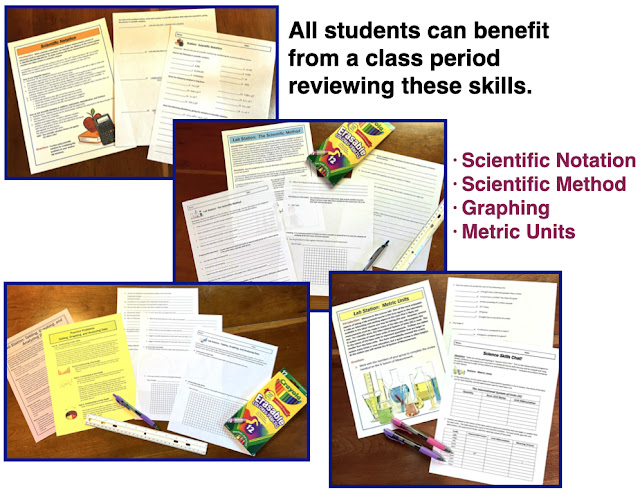
In the first days and weeks of a new school year, I need my students to be proficient in the following:
  • Metric measurement
  • Identification of pieces of lab equipment
  • Scientific method
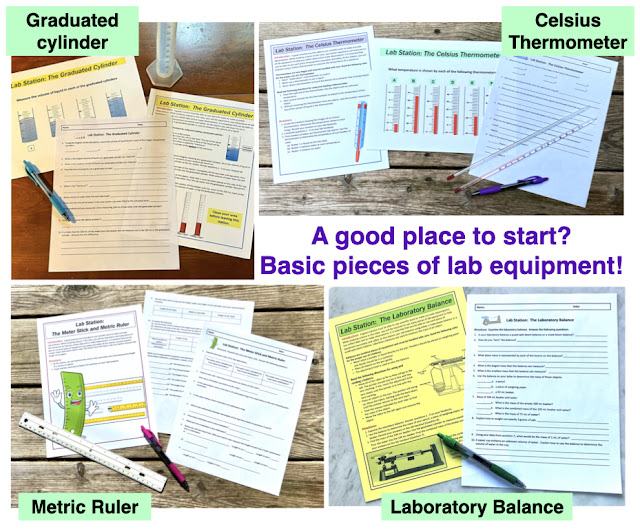
  • Use of basic pieces of lab equipment such as the graduated cylinder, Celsius thermometer, laboratory balance, and metric ruler.
  • Tabling, graphing, and analyzing data.
  • Math skills: Scientific notation, dimensional analysis, significant digits
To accomplish this goal of proficiency of science skills, I have developed Science Skills Chat! -- a set of 17 Lab Stations to address 17 essential science skills all science students should know. I use the word "chat" to emphasize to my students that they are to work together and have a productive discussion at each station in order to maximize their understanding and mastery of the concepts being covered. 

Peer tutoring is a powerful learning tool!


Click on red text or any image to view Science Skills Chat in my TpT store.


What are the 17 Essential Science Skills?
  • Metric Units
  • Identification of Lab Equipment 
  • Scientific Notation
  • Dimensional Analysis
  • Significant Digits
  • The Scientific Method
  • Tabling, Graphing, and Analyzing Data
  • The Graduated Cylinder 
  • The Metric Ruler 
  • The Laboratory Balance 
  • The Celsius Thermometer 
  • The Bunsen Burner 
  • Determining the Volume of Solids 
  • Separating a Mixture 
  • Determining Density 
  • Accuracy, Precision, and Percentage Error
  • Scientific Drawings 


Don't try to complete all 17 lab stations at once. Choose a set of skills (perhaps 4 or 5 lab stations) to be completed during the first week of school. Choose the skills that are of immediate concern to you. Remember, some students may already be proficient in these skills, but other students will be struggling. No matter the ability level, ALL students will benefit from this review and reinforcement. 

Click on red text or any image to view Science Skills Chat in my TpT store.


Once your students have mastered the first set of skills that you deem most important, set up another lab station day to work on skills that students will soon need to know. 

I like the idea of having "Science Skills Friday" where you choose 4 or 5 lab stations to complete. The information in a fewer number of lab stations is not overwhelming, and it is a fun and different way to end the week. There are enough lab stations in Science Skills Chat to create several "Science Skills Friday" sessions.

Click on red text or any image to view Science Skills Chat in my TpT store.


Ten of the lab stations require some sort of lab equipment, but the other 7 skills are perfect activities to leave in your substitute teacher folder. In an emergency, your sub can grab a few of these and create a VERY quality lesson in your absence.

It may seem like you are spending a lot of time at the beginning of the year to cover these 17 science skills, but I guarantee that it is time well spent. As your school year progresses, you will spend far less time repeating and re-teaching skills that your students should already know.  

And, how nice would it be to reduce the number of questions you get every time you go to the lab?


P.S.  I have 11 Chat Lab Station Activities on a variety of topics.  You can view them all here:

👉 If you want a full overview of teaching science skills, read this post on essential science skills. 

Looking for a simple way to strengthen science vocabulary? My Biology Prefixes and Suffixes activity helps students decode unfamiliar scientific terms by breaking words into meaningful parts.


Math and Biology: Math Every Day!


We must increase the use of biology mathematics in our lessons!

I am WAAAAYYYY up high on my soapbox today.  This is year #29 for me in the biology classroom.  I have been seeing this shameful trend for several years now..... Students cannot do math in the biology classroom!

In the past, biology was a largely descriptive science.  We had our students peer into microscopes day after day.  Lab reports consisted of many drawings, hopefully drawn in pretty colors with the "parts" accurately labeled.  Now don't get me wrong;  I still love a microscope.  I can sit for hours and look at drops of pond water.  It is still, after all these years, absolutely fascinating to me!  Moreover, my students still love these types of labs.  However, several years ago, I began to change the type of lab I use in my biology classroom.  I now favor a lab that is quantitative and requires the use of math in biology.

Math & Science:  The Problems I Face Each Day

This is what I see everyday in my classroom.  I know that science teachers everywhere will shake their heads in agreement with these problems.

  • Students cannot do even the simplest of arithmetic without a calculator!  Why, oh why, did we (educators) ever decide it was okay to let students learn math at the elementary levels by using a calculator?  I would like to be the leader of the "Ban the Calculator" movement.  Yes, I am being overly dramatic.  The calculator is a very useful tool, but many of our students are so "calculator-dependent" that they have lost the meaning of the math.

  • Students do not have any common sense when it comes to math.  In their minds, whatever comes up on the calculator display MUST be the right answer. They do not stop to think if the answer is reasonable.  
  • Students cannot do arithmetic.  I wager to say that if I passed out a test that required the use of long division, many of my students might fail.  Further, many students don't know their times tables.  Over and over, I will see a student reach for calculator to multiply two numbers that they should already know!  Funny (but not funny) is that many of my AP Biology students are excelling in AP Calculus, but can't do arithmetic!
  • In the middle school grades, we need to quite teaching algebra and geometry and teach fractions, decimals, and percents every single year.
The Course That I Now Teach? Mathematical Biology!

I am slowly, but surely, changing the types of materials that I use in my class.  I am making more of my labs, activities, worksheets, and homework assignments quantitative in nature.  I am sometimes restricting the use of a calculator during my class.  Recently I purchased a classroom set of four-function calculators.  They only add, subtract, multiple and divide!  When I do allow students to use a calculator in my class, this is the only calculator they get to use.

If you want to make your science class more math-based, I have several products that you might want to consider.  Let's start with the ones that are FREE!  Click on the links below and you can download these "math in biology" lessons for free.


This school year, I developed three new activities that are math-based.  I have already used these in my classes, and I am very pleased with the results.

Have Fun Teaching!