
Amy Brown Science | Biology and Chemistry Teaching Resources for Middle and High School: graphic organizer
menu Home About Me Home Freebies My Store
Amy Brown Science Facebook    Amy Brown Science Instagram    Amy Brown Science Pinterest    Amy Brown Science Teachers Pay Teachers    Email Amy Brown Science

Search My Blog

Real Science Teaching. Real Classroom Experience.

I’m Amy Brown, a veteran high school biology and chemistry teacher, wife, and mom who understands the daily reality of lesson planning, grading, meetings, and everything in between. I know what it feels like to have too much to do and not enough time to do it.

After decades in the classroom, I’ve created rigorous, classroom-tested biology and chemistry resources that save you planning time while still delivering strong, meaningful science instruction. Every lab, activity, and lesson is designed to move students beyond memorization and into real scientific thinking.

If you want your students excited about science and thinking deeply without spending your entire weekend planning, you’re in the right place.

Amy Brown Biology and Chemistry Teacher

“I just love getting kids hooked on science.”

Showing posts with label graphic organizer. Show all posts

Informational Text Reading with Graphic Organizers


Here's a great new free item for your science classroom:  
DNA Informational Text Reading with Graphic Organizers

I teach in a Common Core state, and in a school that is really pushing the implementation of the Common Core State Standards.  We have to show evidence of this implementation in our classroom.  I obviously have to do what is required of me by my admin, but at the same time, I do not want to lose valuable classroom teaching time and get behind on the vast amount of course content that I am also required to teach.

I recently developed this lesson for my students.  In our unit on DNA, RNA, and Protein Synthesis, I love to tell the history of Watson and Crick and their discovery of the structure of the DNA molecule.  In 1953, James Watson and Francis Crick rocked the scientific world with their discovery, and with the publication of their one-page paper in Science magazine describing the DNA molecule.  This one-page paper is a marvelous bit of history, and it is a fascinating read.  It is also a perfect piece of informational text that can be used to teach the Common Core State Standards.

The one-page article can be printed and used in your science classroom.  I developed a 4-page set of graphic organizers to go along with this article.  As students read the article they are required to complete the graphic organizers. You can have your students complete all four organizers (I usually do!) or each graphic organizer can be used alone. The printable lesson is perfect for traditional classroom settings, and the paperless, digital Google Apps version is perfect for distance learning and 1:1 classrooms.

You can, of course, use class time for this activity, but I usually assign this as a homework assignment.  I assign this at the beginning of my unit on DNA, and usually give a week to complete the assignment. The article and the graphic organizers provide great review on the topics I am teaching in class, as well as a lesson in the reading of informational text.  It's a win-win!  (Pssst...This is also a great activity to leave in your sub folder in the event of your unexpected absence from school!)

Here is a look at each of the graphic organizers:


(They look best if printed in color, but print perfectly fine in grayscale.)

This is a free download, and will always remain a free download.  Enjoy!

Related products include:


Free Graphic Organizer for Comparing Groups of Living Plants


Click photo to see all of my
plant products in my TpT store.

One of my goals of late has been to spruce up, improve and update the quality of my teaching materials on plants.  No changes had to made to the content.  I love teaching plants, and I was already doing a great job with the content.  I just wanted to make my materials more attractive and more visually appealing for my students.

So what's new?  I have made a very picture-ific 97-slide PowerPoint presentation, added some crossword puzzles, a set of PowerPoint review questions, and some new daily quizzes.   I have plans for new homework assignments, study guides, and a few new labs I want to try out.  My problem is that I have more ideas than I have time to carry them out!  All in good time, I guess.

At any rate, one of the new things I have just created is a graphic organizer for comparing and contrasting the major groups of living plants. When a lot of new material has been covered, my students sometimes struggle with remembering all the details.  A teaching tool that never fails to work is a graphic organizer. When the content is logically organized and put into place, studying by the student becomes much more effective.

I have listed this new graphic organizer for plants in my TpT store.  It allows the students to compare the liverworts, mosses, ferns, gymnosperms, and angiosperms.  It is a freebie, so be sure to click the links below and grab a copy for yourself.  I hope you find it useful.


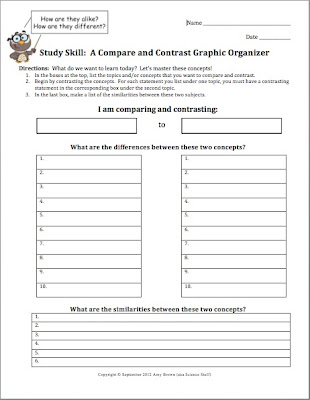
A Compare and Contrast Graphic Organizer


With the increasing amount of information that our students are expected to learn and master, it is more important than ever to provide them with the tools they need to organize and study difficult concepts.

This free graphic organizer can help your students learn to delve deeper into the content to search for similarities and differences between two topics or concepts.

Click image for free download.

This can be used in all subject areas and in grades 4 and up.  My students even admit that this technique has improved the way they view the content that we cover each day.  The graphic organizer can be used to compare and contrast any two topics or concepts.  I have used this organizer to have my students compare and contrast:
  • Photosynthesis to cellular respiration
  • Mitosis to meiosis
  • Protostomes to deuterostomes
  • Vascular plants to nonvascular plants
  • Systems of the body
  • DNA to RNA


The printable version is perfect for traditional classroom settings, and the paperless, digital Google Apps version is perfect for distance learning and 1:1 classrooms.

You can download this free graphic organizer by clicking on any of the above pictures, or on this link:


Enjoy!  ...And have fun teaching!