menu Home About Me Home Freebies My Store
Amy Brown Science Facebook    Amy Brown Science Instagram    Amy Brown Science Pinterest    Amy Brown Science Teachers Pay Teachers    Email Amy Brown Science

Search My Blog

Real Science Teaching. Real Classroom Experience.

I’m Amy Brown, a veteran high school biology and chemistry teacher, wife, and mom who understands the daily reality of lesson planning, grading, meetings, and everything in between. I know what it feels like to have too much to do and not enough time to do it.

After decades in the classroom, I’ve created rigorous, classroom-tested biology and chemistry resources that save you planning time while still delivering strong, meaningful science instruction. Every lab, activity, and lesson is designed to move students beyond memorization and into real scientific thinking.

If you want your students excited about science and thinking deeply without spending your entire weekend planning, you’re in the right place.

Amy Brown Biology and Chemistry Teacher

“I just love getting kids hooked on science.”

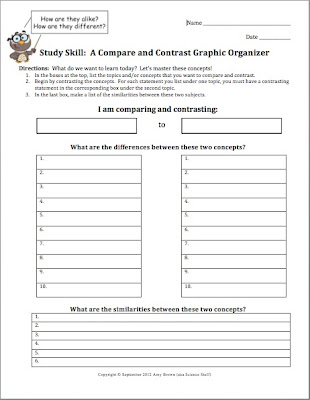
A Compare and Contrast Graphic Organizer


With the increasing amount of information that our students are expected to learn and master, it is more important than ever to provide them with the tools they need to organize and study difficult concepts.

This free graphic organizer can help your students learn to delve deeper into the content to search for similarities and differences between two topics or concepts.

Click image for free download.

This can be used in all subject areas and in grades 4 and up.  My students even admit that this technique has improved the way they view the content that we cover each day.  The graphic organizer can be used to compare and contrast any two topics or concepts.  I have used this organizer to have my students compare and contrast:
  • Photosynthesis to cellular respiration
  • Mitosis to meiosis
  • Protostomes to deuterostomes
  • Vascular plants to nonvascular plants
  • Systems of the body
  • DNA to RNA


The printable version is perfect for traditional classroom settings, and the paperless, digital Google Apps version is perfect for distance learning and 1:1 classrooms.

You can download this free graphic organizer by clicking on any of the above pictures, or on this link:


Enjoy!  ...And have fun teaching!


Math and Biology: Math Every Day!


We must increase the use of biology mathematics in our lessons!

I am WAAAAYYYY up high on my soapbox today.  This is year #29 for me in the biology classroom.  I have been seeing this shameful trend for several years now..... Students cannot do math in the biology classroom!

In the past, biology was a largely descriptive science.  We had our students peer into microscopes day after day.  Lab reports consisted of many drawings, hopefully drawn in pretty colors with the "parts" accurately labeled.  Now don't get me wrong;  I still love a microscope.  I can sit for hours and look at drops of pond water.  It is still, after all these years, absolutely fascinating to me!  Moreover, my students still love these types of labs.  However, several years ago, I began to change the type of lab I use in my biology classroom.  I now favor a lab that is quantitative and requires the use of math in biology.

Math & Science:  The Problems I Face Each Day

This is what I see everyday in my classroom.  I know that science teachers everywhere will shake their heads in agreement with these problems.

  • Students cannot do even the simplest of arithmetic without a calculator!  Why, oh why, did we (educators) ever decide it was okay to let students learn math at the elementary levels by using a calculator?  I would like to be the leader of the "Ban the Calculator" movement.  Yes, I am being overly dramatic.  The calculator is a very useful tool, but many of our students are so "calculator-dependent" that they have lost the meaning of the math.

  • Students do not have any common sense when it comes to math.  In their minds, whatever comes up on the calculator display MUST be the right answer. They do not stop to think if the answer is reasonable.  
  • Students cannot do arithmetic.  I wager to say that if I passed out a test that required the use of long division, many of my students might fail.  Further, many students don't know their times tables.  Over and over, I will see a student reach for calculator to multiply two numbers that they should already know!  Funny (but not funny) is that many of my AP Biology students are excelling in AP Calculus, but can't do arithmetic!
  • In the middle school grades, we need to quite teaching algebra and geometry and teach fractions, decimals, and percents every single year.
The Course That I Now Teach? Mathematical Biology!

I am slowly, but surely, changing the types of materials that I use in my class.  I am making more of my labs, activities, worksheets, and homework assignments quantitative in nature.  I am sometimes restricting the use of a calculator during my class.  Recently I purchased a classroom set of four-function calculators.  They only add, subtract, multiple and divide!  When I do allow students to use a calculator in my class, this is the only calculator they get to use.

If you want to make your science class more math-based, I have several products that you might want to consider.  Let's start with the ones that are FREE!  Click on the links below and you can download these "math in biology" lessons for free.


This school year, I developed three new activities that are math-based.  I have already used these in my classes, and I am very pleased with the results.

Have Fun Teaching!

Why Do Living Cells Need pH Buffers? A Homeostasis Lab for Biology


Why Living Cells Must Maintain Homeostasis

Living cells must carefully regulate their internal environment in order to survive. Many of the chemical reactions that occur inside cells produce byproducts that can change the pH of the cell. Even small changes in pH can disrupt enzyme function, alter protein structure, and interfere with essential biochemical reactions.

Maintaining a stable internal environment is called homeostasis. One critical part of cellular homeostasis is maintaining a nearly constant internal pH. If the pH of a cell shifts too far from its optimal range, the cell can be damaged or even die. To prevent this, living cells produce substances that stabilize internal pH.

These substances are called buffers. This is why living cells need pH buffers to maintain homeostasis and survive in changing conditions.

What Are pH Buffers and How Do They Work?

A buffer is defined as:

“A substance that consists of acid and base forms in a solution and that minimizes changes in pH when extraneous acids or bases are added to the solution.”

Carbonic acid bicarbonate buffer system showing H2CO3, HCO3-, and H+ regulating blood pH to maintain homeostasis

In simple terms, buffers resist sudden changes in pH. They do this by:

  • Accepting hydrogen ions (H⁺) when they are in excess

  • Donating hydrogen ions when they have been depleted

This stabilizing action helps maintain internal balance inside cells.


A powerful example of buffering in living systems is human blood. The pH of human blood is approximately 7.4. A person cannot survive for long if blood pH drops to 7.0 or rises to 7.8. Buffer systems in the blood prevent dangerous swings in hydrogen ion concentration and keep the pH within a narrow range.

Most living cells maintain an internal pH close to neutral, typically around 7.2, although this can vary slightly depending on cell type and location.

Even small changes in pH are important in biology because enzymes are highly sensitive to their environment. A slight shift in pH can change the shape of an enzyme and reduce or eliminate its ability to function.

Simple Controlled Experiment: Testing pH Changes in Living Cells


This concept becomes incredibly clear through a simple but powerful lab activity. It is easy to set up, requires minimal equipment, and consistently produces impressive results. 

If you are looking for a ready-to-use biology lab on pH buffers and homeostasis, you can find my complete activity, "Cells and pH: A Biochemistry Homeostasis Enzyme Lab" here.

Part 1: Control With Tap Water

Students begin by placing tap water in a beaker. They add drops of dilute acid one drop at a time and record the pH after each addition. They repeat the procedure using a dilute base.

As expected, the pH drops significantly when acid is added and rises significantly when base is added. This serves as the control. Water does not produce buffers, so there is nothing to resist the pH change.

Part 2: Testing Liver Cells

Next, students test a liver homogenate, which is liver tissue blended with water. When acid or base is added to the liver solution, there is very little change in pH.

Students often assume their pH meter is malfunctioning because the readings barely change. That moment is powerful. It becomes immediately clear that the living cells are producing buffer systems that resist dramatic pH shifts.

Raw liver and potato used to demonstrate pH buffering in animal and plant cells during homeostasis lab

Part 3: Testing Plant Cells With Potato

Repeating the procedure with raw potato demonstrates that plant cells also contain buffering systems. Again, the pH changes very little compared to the water control.

This reinforces the idea that buffering is a universal cellular mechanism found in both animal and plant cells.

How This Lab Demonstrates Homeostasis in Action

This lab is a direct model of cellular homeostasis.

Water lacks regulatory systems, so its pH changes dramatically. Living cells, however, contain internal chemical systems that stabilize their environment.

While diffusion and osmosis regulate the movement of substances across membranes, buffer systems regulate the internal chemical balance of the cell. This makes it an excellent reinforcement activity when teaching cell homeostasis, enzyme function, or biological feedback mechanisms. Together, these mechanisms help cells maintain homeostasis and survive in changing conditions.

The minimal pH change observed in liver and potato solutions is clear evidence of biological regulation at work.

Data Collection and Graphing in Biology

One of the strongest aspects of this lab is the emphasis on quantitative data and graphing.

Students:

  • Record pH after each drop of acid or base

  • Organize large amounts of data in tables

  • Graph pH versus number of drops added

  • Compare slopes between water and living cell samples

  • Analyze trends and explain differences

The contrast between the steep slope of water and the nearly flat slope of liver or potato makes the concept visually obvious. Students are not simply told that buffers work. They see the evidence in their own data.

This lab reinforces graphing skills, data interpretation, and experimental analysis while teaching a core biological concept. For many students, the graph makes the concept of homeostasis more concrete than a textbook definition ever could.

Digital pH meter measuring solution in beaker during biology lab on pH buffers and homeostasis

Equipment and Setup

I use a digital pH meter for this lab. The models I have used are affordable, durable, and long lasting. Batteries are easily replaceable and rarely need to be changed.

If pH meters are not available, this lab can also be conducted using pH paper with excellent results.

The materials are simple, the setup is straightforward, and the experiment works consistently every year.


Frequently Asked Questions About pH in Living Cells

Why do all living cells need pH buffers to maintain homeostasis?
Cells need pH buffers to maintain a stable internal environment so enzymes and metabolic reactions can function properly.

What is the pH inside most living cells?
Most cells maintain an internal pH close to neutral, typically around 7.2, although this varies slightly by cell type.

Why are small changes in pH so important in biology?
Even small pH changes can alter protein structure and enzyme activity, disrupting essential chemical reactions.

What substances are produced by cells to prevent sudden changes in pH?
Cells contain buffer systems composed of weak acids and weak bases that resist sharp changes in hydrogen ion concentration.

Why Teachers Love This Lab

This is one of my favorite labs to teach because it:

  • Clearly demonstrates the concept of buffers

  • Provides a powerful model of homeostasis

  • Requires careful lab technique

  • Emphasizes data collection and graphing

  • Engages students with dramatic, visible results

It is appropriate for Grade 9 and up and fits beautifully into units on cell homeostasis, internal regulation, enzymes, or biochemistry.

If you would like a complete, classroom-ready lab that clearly demonstrates pH regulation and cellular homeostasis, you can view it by clicking the image below.




Population Ecology Lab: Estimating Population Size


I have always found it difficult to find quality labs to use with my students when teaching my units on ecology. My school is on a busy city street, we have no access to a pond or woods, and only very limited access to grass in the school yard! Therefore, any labs we do in ecology have to be labs that can be carried out within the classroom or within the laboratory. One lab that works really well in my population ecology unit is "The Wild Bean Population."

In order to effectively study living organisms, scientists often need to know the size of a given population. A population is a group of organisms of the same species that live in the same general area. It is not reasonable to think that every individual in the population can be counted, and it is often difficult to get an accurate estimation of population size since organisms tend to hide, move around, etc. 

Population biologists have developed several methods for sampling a population. In this lab, you will use the sampling technique known as “the mark and recapture method” to estimate the size of a population of wild beans! This method involves "capturing" a number of individuals from a population, marking or tagging them, and then releasing them back into the wild.   

Anyone can do this lab since it uses very simple materials! All you need is dry white navy beans, dry red pinto beans, and a brown lunch sack.


The white beans represent the population of wild beans that lives within the brown paper sack. Students grab a handful of beans and remove them from the sack. This represents the initial capture of organisms. The white beans are counted, marked and returned to the sack. 

The easiest way to do this would be to have the students mark each bean with a Sharpie before returning it to the sack. I teach 5 biology classes, and did not want to have to throw away that many marked beans at the end of each class. My solution was to have the students replace the white beans from the initial capture with red beans. The red beans represent organisms that were initially captured and returned to their environment.

At a later time, a second capturing is conducted. Some of the organisms in the second recapture were previously marked while others in the second recapture will have no mark. If you know the following information: (1) The number of individuals initially marked, (2) the total number of individuals recaptured in the second group, and (3) the number of marked individuals in the second recapture, it is possible to make an estimation as to the total population size.  

This lab satisfied three objectives:
  • To learn the “mark and recapture” technique for estimating the size of a population.
  • To calculate the size of a population from given data.
  • To make predictions about the size of a population under various conditions.


I generally do not like "simulation-type" labs such as this one, but I am always very pleased with the results and the concepts that my students learn from this lab. The students are able to carry out mathematical calculations to determine the population size, and calculate their percent error. The final analysis questions are thought provoking and require critical thinking skills. All in all, this has all the components of a great lab activity.